
Full load current is the single most important number you need before you can size a cable, select a circuit breaker, set an overload relay, or choose a contactor for a motor installation. Get it wrong and everything downstream of that number is wrong too. Size your cable based on an incorrect FLA and you either waste money on an oversized conductor or create a thermal hazard in an undersized one.
I have commissioned dozens of motor control panels over the years, and the number of times I have seen overload relays set incorrectly because the full load current was calculated from the wrong formula or the wrong power factor assumption is more than I would like to admit. This article walks through the correct calculation from first principles, applies it to the motor sizes you are most likely to encounter in the field, and explains the assumptions behind the formula so you know when those assumptions need adjusting.
What is Full Load Current?
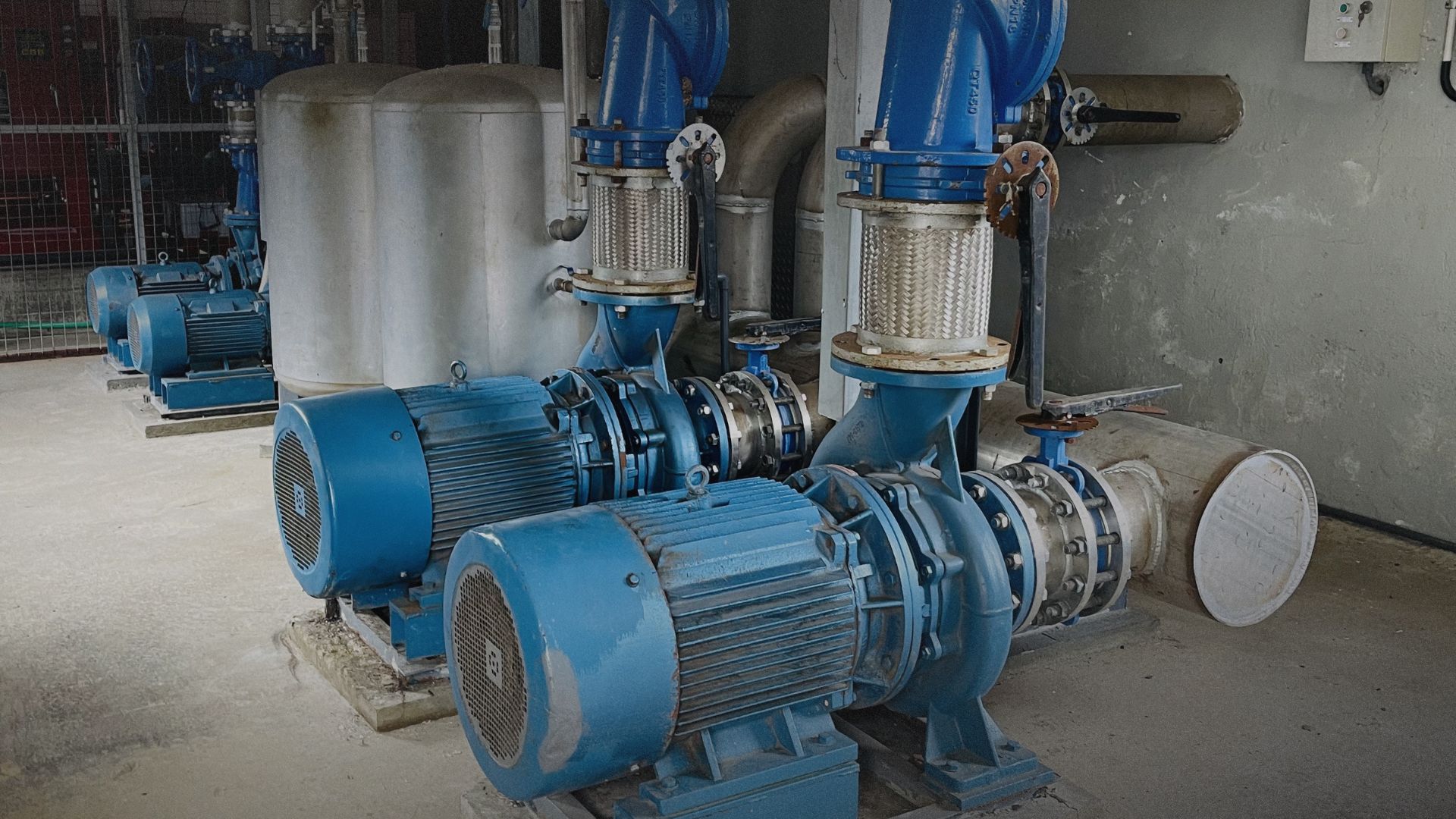
Full load current (FLC), sometimes called full load amps (FLA), is the current a motor draws from the supply when it is running at its rated power output under rated voltage and frequency conditions. It is the steady-state operating current the motor produces when it is doing the work it was designed to do at its nameplate rating.
It is important to understand what full load current is not. It is not the starting current, which for a direct-on-line started motor can be 5 to 8 times the full load current for several seconds during acceleration. It is also not the no-load current, which is the current the motor draws when it is spinning freely with nothing connected to the shaft. Both of those currents are higher and lower respectively than full load current, and confusing them leads to sizing errors.
The nameplate on every motor should display the full load current directly. In practice though, you often need to calculate it before the motor has been procured, or you are working from a power rating in a specification that does not include electrical data. That is when the formula becomes essential.
The Formula
For a three-phase motor, full load current is calculated from the power, voltage, power factor, and efficiency using the following relationship.
Full Load Current (A) = P / (√3 × V × PF × η)
Where P is the motor shaft output power in watts, V is the line-to-line supply voltage in volts, PF is the motor power factor at full load (a dimensionless number between 0 and 1), and η (eta) is the motor efficiency at full load (also a dimensionless number between 0 and 1).
The square root of 3, which equals approximately 1.732, appears because we are working with a three-phase supply where the line voltage is 1.732 times the phase voltage. If you were calculating single-phase current instead, the formula would use just the supply voltage without the root 3 factor.
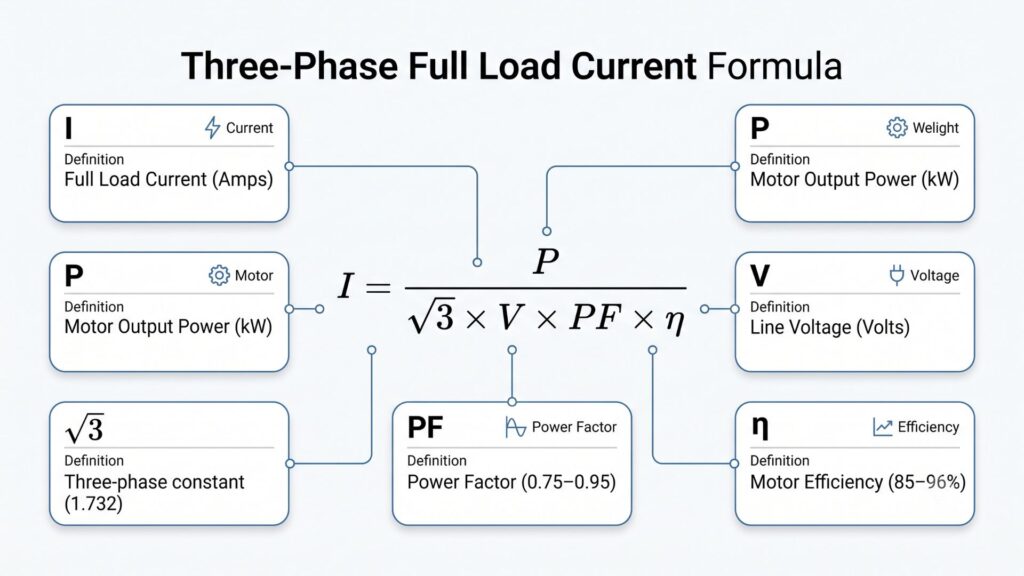
The reason efficiency and power factor both appear in the denominator is that the motor has to draw more electrical power from the supply than it delivers at the shaft. Efficiency accounts for the losses inside the motor itself (copper losses, iron losses, friction and windage). Power factor accounts for the reactive current the motor draws to maintain its magnetic field, which contributes to the apparent power without appearing in the shaft output.
Typical Values for Power Factor and Efficiency
This is where most quick calculations go wrong. People use generic assumed values for power factor and efficiency without checking whether those values are appropriate for the motor size and type they are working with.
For standard IEC frame squirrel cage induction motors at full load, efficiency and power factor both vary significantly with motor size. Small motors below 2.2kW typically have efficiencies in the 75% to 82% range and power factors between 0.72 and 0.80. Medium motors in the 5.5kW to 30kW range are more efficient, typically 88% to 92% efficient with power factors between 0.82 and 0.88. Large motors above 55kW generally achieve efficiencies of 92% to 95% and power factors between 0.86 and 0.92.
Using a blanket 0.85 for both power factor and efficiency gives a reasonable estimate for motors in the 5kW to 30kW range, but it can overestimate the current for large motors and underestimate it for small ones. Whenever the motor nameplate or datasheet is available, use the published values rather than assumed ones.
For motors complying with IE3 efficiency class (which is now mandatory in many countries for motors above certain ratings), the efficiency values are higher than older IE2 or IE1 motors, which means the full load current will be slightly lower than an older motor of the same rated power.
Worked Examples
Let us work through several common motor sizes to show how the calculation applies in practice.
Example 1: 7.5kW motor at 415V, three-phase, 50Hz
Assumed values: power factor 0.84, efficiency 0.89
FLC = 7,500 / (1.732 × 415 × 0.84 × 0.89)
FLC = 7,500 / (1.732 × 415 × 0.7476)
FLC = 7,500 / 537.6
FLC = 13.95A, round to 14A
Example 2: 11kW motor at 415V, three-phase, 50Hz
Assumed values: power factor 0.85, efficiency 0.90
FLC = 11,000 / (1.732 × 415 × 0.85 × 0.90)
FLC = 11,000 / (1.732 × 415 × 0.765)
FLC = 11,000 / 550.2
FLC = 19.99A, round to 20A
Example 3: 22kW motor at 415V, three-phase, 50Hz
Assumed values: power factor 0.86, efficiency 0.91
FLC = 22,000 / (1.732 × 415 × 0.86 × 0.91)
FLC = 22,000 / (1.732 × 415 × 0.7826)
FLC = 22,000 / 562.8
FLC = 39.1A, round to 39A
Example 4: 37kW motor at 415V, three-phase, 50Hz
Assumed values: power factor 0.87, efficiency 0.92
FLC = 37,000 / (1.732 × 415 × 0.87 × 0.92)
FLC = 37,000 / (1.732 × 415 × 0.8004)
FLC = 37,000 / 575.5
FLC = 64.3A, round to 64A
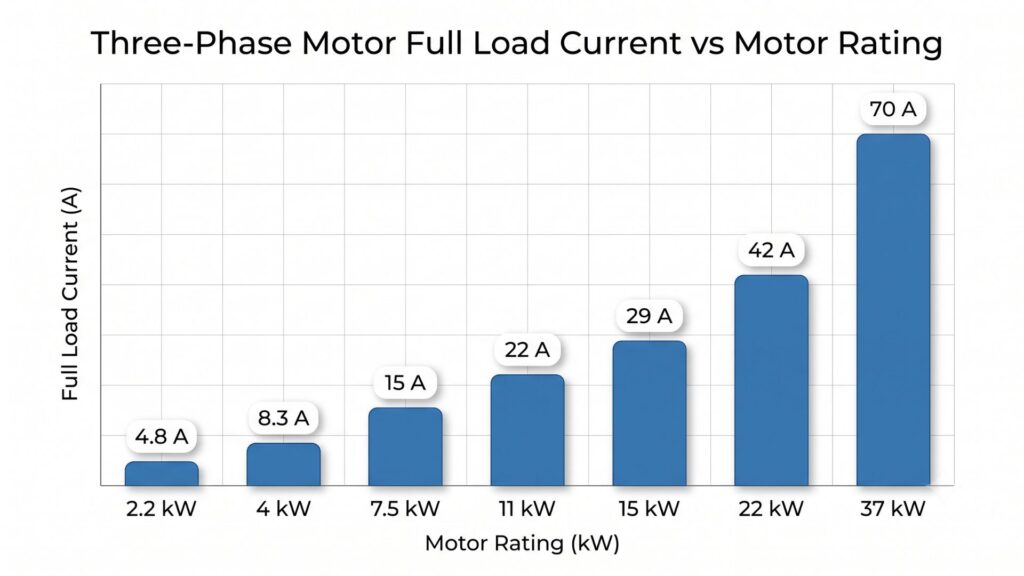
These results align closely with the nameplate values published by major motor manufacturers for standard IEC motors. The small variations between manufacturer nameplates and calculated values come from differences in actual efficiency and power factor for specific motor designs.
Verifying Against the Motor Nameplate
If you have access to the motor nameplate, always verify your calculated FLC against the nameplate value before finalising any cable or protection sizing. The nameplate current is measured by the manufacturer and represents the actual operating current of that specific motor design, not a theoretical calculated value.

A motor nameplate will show the FLC for each voltage rating the motor supports. Three-phase motors are often dual-rated, for example 220/380V or 380/660V, meaning they can be connected in either delta or star to suit the available supply. A 415V supply motor running delta connected will have a different nameplate FLC than the same motor running star connected at 660V.
If the calculated FLC differs from the nameplate value by more than 5% to 8%, check whether you are using the correct voltage, whether the power factor and efficiency assumptions are appropriate for that motor size, and whether the motor has a non-standard efficiency class or design.
How Full Load Current is Used in Design
Once you have the full load current, it becomes the reference value for every downstream sizing decision.
For cable sizing, the cable must have a current carrying capacity at least equal to the full load current, with derating applied for ambient temperature, grouping, and installation method. The cable also needs to be checked for voltage drop over the length of the run.
For circuit breaker or fuse selection, the protective device rating is typically set at 125% of FLC for motors to allow for normal starting and overload conditions without nuisance tripping, following IEC 60947 recommendations. The exact multiplier depends on the starting method and the protective device type.
For overload relay setting, the relay is set between 95% and 105% of the motor’s nameplate FLC in most standard applications. Setting it too low causes nuisance tripping during normal operation. Setting it too high leaves the motor inadequately protected against sustained overloads that could damage the winding insulation.
For contactor selection, the contactor must have an AC3 utilisation category rating at least equal to the motor full load current at the system voltage.
Use the EngCal Motor Full Load Current Calculator to calculate FLC quickly for any motor power, voltage, power factor, and efficiency combination without working through the formula manually each time.
Special Cases to Be Aware Of
Soft starters and variable frequency drives change how you approach the current calculation in some respects. A VFD draws current from the supply at a different power factor and waveform than a direct-on-line started motor. The input current to the VFD for a given motor output load can actually be higher than the motor nameplate current because of the harmonic content in the VFD input current and the efficiency of the drive itself. When sizing cables and protection for a VFD installation, always refer to the drive manufacturer’s input current data rather than relying solely on the motor FLC formula.
Motors with a service factor above 1.0 on the nameplate are designed to carry load above their rated power for limited periods. A motor with a 1.15 service factor can run at 115% of rated power without damage. In these cases, the overload relay should be set to the service factor current rather than the base FLC if the application requires the motor to run at the service factor load level regularly.
Frequently Asked Questions
What is the difference between full load current and rated current?
They refer to the same value. Full load current and rated current both describe the current a motor draws from the supply when operating at its nameplate rated power output under rated voltage and frequency. Some manufacturers use one term and some use the other, but they mean the same thing in the context of motor nameplate data.
Why does my measured motor current sometimes exceed the nameplate FLC?
If a motor running in service draws more current than its nameplate FLC, the most common reasons are that the mechanical load exceeds the rated output, the supply voltage is lower than the rated voltage (lower voltage means higher current for the same power), the power factor has degraded because the motor is running in an abnormal condition, or the motor has developed an internal fault such as shorted turns in the stator winding. Any measured current consistently above 105% of FLC warrants investigation.
Can I use the same formula for single-phase motors?
For single-phase motors, the formula is FLC = P / (V × PF × η) with no root 3 factor. The voltage in the formula is the single-phase supply voltage, typically 230V in IEC countries. Single-phase motors tend to have lower efficiency and power factor than equivalent three-phase motors, so use the nameplate values if available.
How does supply voltage variation affect full load current?
For a constant mechanical load, current varies approximately inversely with voltage. If the supply voltage drops by 5%, the motor current rises by approximately 5% to deliver the same shaft output. IEC 60034 allows motors to operate within plus or minus 10% of rated voltage, but operation at the lower end of this range results in higher current and more heat in the windings.
What current should I use to size the overload relay for a motor with a service factor of 1.15?
If the application requires the motor to operate at its service factor load, set the overload relay at the service factor current, which is FLC multiplied by the service factor. For a 14A FLC motor with a 1.15 service factor, the overload relay would be set at 14 × 1.15 = 16.1A. If the motor will only ever run at or below rated load, set the relay at FLC.
Conclusion
Full load current is the foundation of almost every motor circuit sizing decision, and getting it right from the start saves time, money, and headaches during commissioning. The formula is straightforward once you understand what each variable represents and why the efficiency and power factor appear where they do. For standard IEC motors in the 5kW to 37kW range at 415V, the formula gives results that align closely with nameplate data when realistic values are used for power factor and efficiency.
Always cross-check against the motor nameplate when it is available, and remember that starting current, service factor loads, and VFD applications all introduce considerations that go beyond the basic FLC calculation.
Use the EngCal Motor Full Load Current Calculator to calculate full load current for any combination of motor rating, voltage, power factor, and efficiency in seconds.