
This is one of those questions that comes up constantly, whether you are sizing a solar backup system, shopping for a home UPS, or trying to figure out if your existing battery bank is actually big enough for what you need. And honestly, it is one of those questions that has a deceptively simple answer on the surface but gets a lot more interesting once you start digging into the real numbers.
I have been working in electrical engineering for over ten years, and battery sizing is something I see done wrong all the time. Not necessarily by careless people, just by people who grabbed the quick formula without accounting for what actually happens in a real installation. A 200Ah battery running a 500W load does not behave the way the label suggests, and by the time you finish reading this, you will know exactly why and how to calculate it properly.
What Does 200Ah Actually Mean?
Before anything else, it helps to be clear on what the ampere-hour rating on a battery actually tells you. A 200Ah battery has a theoretical capacity to deliver 200 amperes for one hour, or 10 amperes for 20 hours, or any other combination that multiplies out the same way. The rating is typically measured at the C20 rate, which means the battery is discharged fully over a 20 hour period.
The reason this matters is something called the Peukert effect. If you discharge a battery much faster than its rated rate, the effective capacity drops. A 200Ah battery being drained hard at 80 or 100 amps will not give you the full 200Ah worth of energy before the voltage drops out. For the load we are working with here the discharge rate is moderate enough that this is not a major concern, but it is worth knowing about for heavier loads.
For now, we are working with a standard 12V, 200Ah battery and a 500W load.
The Starting Point: The Basic Calculation
The most straightforward way to approach this is to convert the battery capacity into watt-hours first, then divide by the load.
To get watt-hours, you multiply the battery capacity by its nominal voltage.
Energy = 200Ah x 12V = 2,400 Wh
Now divide by the load to get the runtime.
Runtime = 2,400 Wh / 500W = 4.8 hours
So the headline answer is 4.8 hours. If you have seen this figure quoted on a forum or in a product description, this is where it comes from. The problem is that this number assumes you can use every single watt-hour in the battery and that your inverter wastes nothing in the process. Neither of those things is true in practice, and the difference between this theoretical figure and your real-world runtime is significant.
Depth of Discharge: You Cannot Use the Whole Battery
This is the bit that catches people out most often. Most batteries, particularly lead-acid types which includes AGM and gel batteries, should never be fully discharged. Pushing a lead-acid battery down to zero repeatedly causes irreversible damage to the internal plates and dramatically reduces the battery’s usable lifespan. It is not a soft guideline either. It genuinely wrecks the battery faster than most people expect.
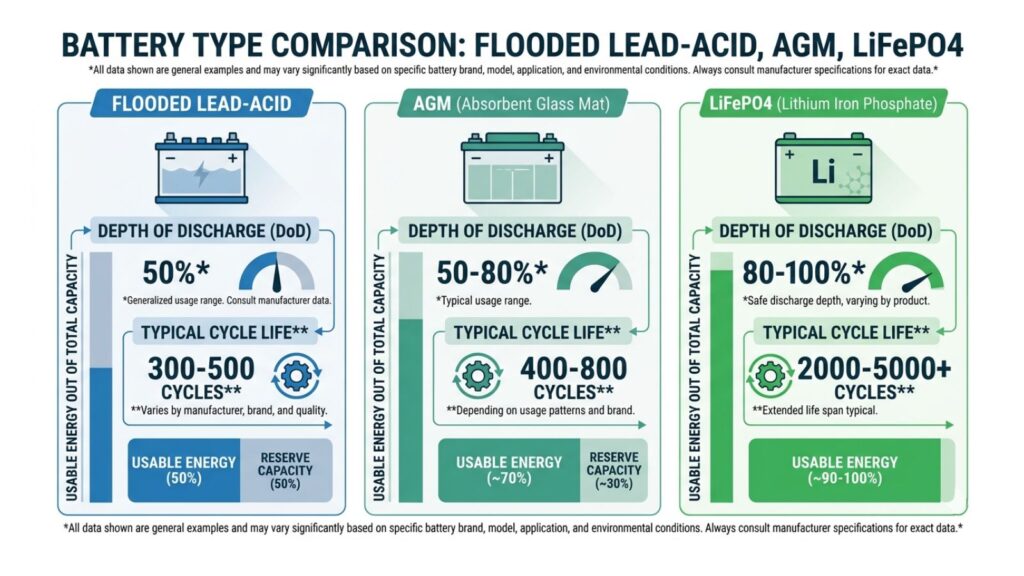
The rule of thumb for flooded lead-acid batteries is a 50% depth of discharge (DoD) limit. For AGM batteries the limit is similar, typically in the 50 to 60% range. Lithium iron phosphate batteries, known as LiFePO4, are a different story. They can handle 80 to 90% depth of discharge on a regular basis without significant degradation, which is one of the main engineering reasons they have become the preferred chemistry for solar and backup installations despite costing more upfront.
Let’s see how this changes the usable energy in our 200Ah battery.
For a lead-acid or AGM battery at 50% DoD: Usable Energy = 2,400 Wh x 0.50 = 1,200 Wh
For a LiFePO4 battery at 80% DoD: Usable Energy = 2,400 Wh x 0.80 = 1,920 Wh
That is a meaningful difference from the same Ah rating, and it only comes down to battery chemistry and how aggressively you are willing to discharge.
Inverter Efficiency: The Loss You Did Not See Coming
Unless you are running a 12V DC appliance directly off the battery terminals, you are using an inverter to convert the DC battery voltage into 230V AC (or 120V AC depending on your region). Every inverter introduces conversion losses. No inverter is 100% efficient, and the ones that come closest are the expensive ones.
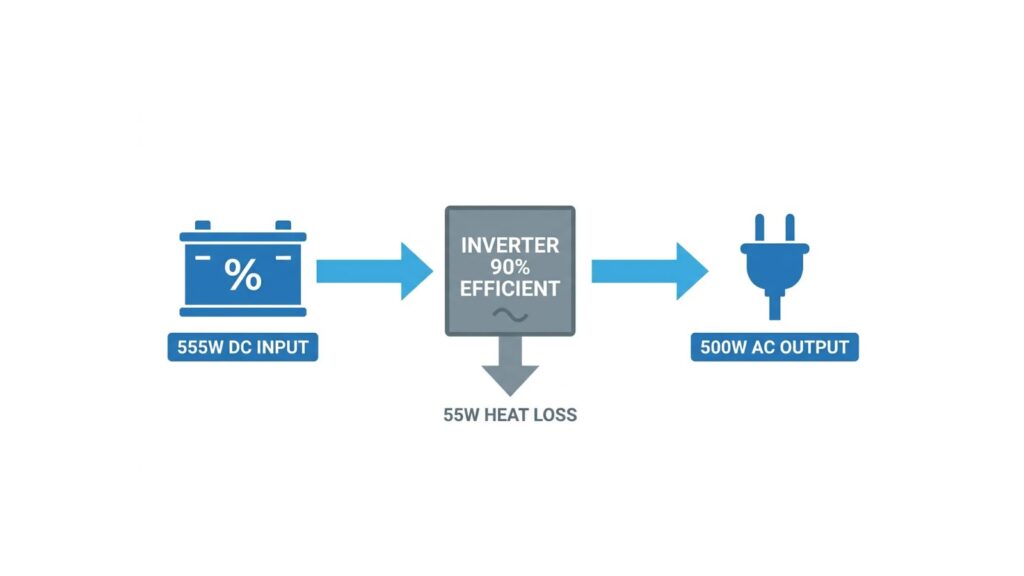
A typical quality inverter operates at around 85 to 92% efficiency under normal loading conditions. Budget units can drop to 80% or below. For this calculation I will use 90%, which is a reasonable figure for a decent mid-range inverter.
What this means in practice is that to deliver 500W of AC power to your load, the inverter actually needs to draw more than 500W from the battery. The extra goes to heat and switching losses inside the inverter itself.
Actual battery draw = 500W / 0.90 = 555.6W
That extra 55 watts does not sound like much, but over several hours it adds up to a meaningful reduction in runtime. This is the efficiency tax that most back-of-the-napkin calculations completely skip.
The Full Calculation With All Real-World Factors
Now we can put everything together into one formula that actually reflects what happens in the field.
Runtime (hours) = (Battery Capacity Ah x Voltage V x DoD) / (Load W / Inverter Efficiency)
Scenario 1: AGM Battery, 50% DoD, 90% Inverter Efficiency”
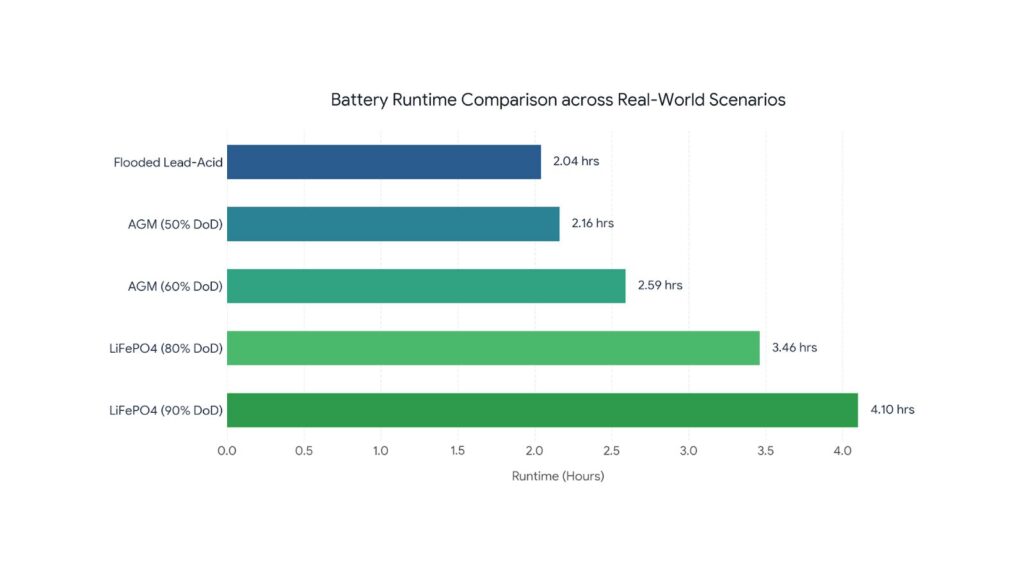
Usable Energy = 200 x 12 x 0.50 = 1,200 Wh Actual draw from battery = 500 / 0.90 = 555.6W Runtime = 1,200 / 555.6 = 2.16 hours, roughly 2 hours and 10 minutes
Scenario 2: LiFePO4 Battery, 80% DoD, 90% Inverter Efficiency
Usable Energy = 200 x 12 x 0.80 = 1,920 Wh Actual draw from battery = 500 / 0.90 = 555.6W Runtime = 1,920 / 555.6 = 3.46 hours, roughly 3 hours and 27 minutes
Compare those figures to the theoretical 4.8 hours and you start to understand why so many backup systems underperform expectations. The gap is not a fault of the battery brand or the installer. It is just physics being ignored at the sizing stage.
What About 24V or 48V Battery Banks?
A lot of solar and backup installations above 1kW use 24V or 48V battery banks rather than a single 12V battery. The calculation method is exactly the same, the only thing that changes is the voltage you multiply by.
For a 24V bank made from two 200Ah 12V batteries connected in series, the total energy is:
Energy = 200Ah x 24V = 4,800 Wh
Applying 80% DoD and 90% inverter efficiency at a 500W load:
Runtime = (4,800 x 0.80) / (500 / 0.90) = 3,840 / 555.6 = 6.91 hours
That is nearly seven hours from the same Ah rating, just at a higher voltage. This is one of the key engineering reasons that higher-voltage battery banks are preferred for larger loads. You get more energy from the same capacity label, and you also get the benefit of lower current on the DC side which means smaller cables and reduced resistive losses.
Other Things That Affect Your Real-World Runtime
Even with depth of discharge and inverter efficiency accounted for, there are a few more variables worth knowing about.
Temperature has a bigger effect on battery performance than most people expect. Lead-acid batteries lose capacity noticeably in cold weather. At around 0 degrees Celsius, the same battery that delivers its full rated capacity at 25 degrees might only give you 70 to 80% of that. If your battery bank sits in an unheated garage or outdoor enclosure over winter, factor this in. LiFePO4 batteries are more stable in cold but should never be charged at temperatures below freezing as this can cause lithium plating inside the cells.
Battery age is another factor that is easy to overlook, especially when evaluating an existing system. A lead-acid battery that has gone through several hundred charge and discharge cycles may only hold 70 to 80% of its original capacity. The battery still accepts a charge and appears functional, but it simply does not store as much energy as it once did. Running a load capacity test periodically is the only reliable way to know where you actually stand.
 Cable sizing on the DC side is worth mentioning too, particularly for 12V systems where high currents flow through relatively long runs. Drawing 55 amps from a battery through undersized cabling creates a voltage drop that reduces the power reaching your inverter and, by extension, your load. This is not just an efficiency concern, it also generates heat in the cables which is a safety issue at high currents. Correct cable sizing from battery to inverter is as important as anything on the AC side.
Finally, there are parasitic loads. Many inverters draw 5 to 15 watts at idle just to stay on and ready. Monitoring systems, control circuits, and alarm panels all add small but constant loads. Over a four or five hour backup window, these small draws consume a meaningful slice of your usable energy.
How to Size a Battery Bank the Right Way
The correct approach to battery sizing is to start from what you need and work backwards, not to start from a battery you already own and see how long it lasts. Here is how that looks in practice.
Say you need four hours of backup for a 500W load using AGM batteries. The energy your load needs is 500W x 4 hours = 2,000 Wh at the AC output. To account for 90% inverter efficiency, the battery needs to supply 2,000 / 0.90 = 2,222 Wh. Since you can only use 50% of an AGM battery’s rated capacity, the total rated energy you need is 2,222 / 0.50 = 4,444 Wh. At 12V, that works out to 4,444 / 12 = 370Ah of rated battery capacity.
That is nearly double a 200Ah battery, just for four hours at 500W with a standard AGM chemistry. This is why undersized battery banks are one of the most common failure points in solar and backup installations. The maths feels counterintuitive until you work through it properly.
Use the EngCal Battery Backup Time Calculator to run any combination of battery size, voltage, load, depth of discharge, and inverter efficiency instantly without needing to work through the formula by hand each time.
Frequently Asked Questions
How long will a 200Ah 12V battery last with a 500W load in real-world conditions?
For a lead-acid or AGM battery with a 50% depth of discharge limit and a 90% efficient inverter, you can realistically expect around 2 hours and 10 minutes of runtime. With a LiFePO4 battery at 80% depth of discharge under the same conditions, that extends to roughly 3 hours and 27 minutes.
Does battery voltage affect how long it lasts at a given watt load?
Yes, directly. A higher-voltage battery bank of the same Ah rating stores proportionally more watt-hours. A 200Ah battery at 24V holds 4,800Wh compared to 2,400Wh at 12V, giving you roughly double the runtime for the same load.
Should I fully discharge my 200Ah battery to get maximum runtime?
No. For lead-acid and AGM batteries, going below 50% discharge regularly will shorten the battery’s life considerably. LiFePO4 batteries handle 80 to 90% discharge well, but even those should not be taken to zero on a routine basis.
What is the best battery chemistry for a 500W backup load?
For a long-term installation where cycle life and usable capacity matter, LiFePO4 is the better engineering choice. For budget-conscious installations, AGM batteries work reliably as long as you size them correctly and respect the discharge limits.
How does temperature affect a 200Ah battery’s runtime?
Significantly, especially for lead-acid types. A 200Ah lead-acid battery operating at 0 degrees Celsius may only deliver around 140 to 160Ah of effective capacity. LiFePO4 handles cold better but must not be charged in freezing temperatures.
Conclusion
A 200Ah battery running a 500W load does not give you 4.8 hours. That is the theoretical ceiling and it is rarely achievable in a real installation. For an AGM battery with a standard inverter, you are looking at just over two hours. With a quality LiFePO4 battery and a good inverter, you can push that to three and a half hours or more.
The numbers that matter are depth of discharge, inverter efficiency, temperature, and the actual age and condition of your battery. Get those right in your calculations and you will size systems that actually perform as expected rather than ones that leave you short when the power goes out.
If you are planning or reviewing a backup or solar system, the EngCal Battery Backup Time Calculator will save you a lot of manual work and help you get the sizing right from the start.