
If you have ever connected a motor-driven load to a generator and watched the generator struggle, trip, or fail to start the equipment properly, you are not alone. This is one of the most common mistakes people make when selecting backup power. They look at the running wattage of the motor, pick a generator that seems large enough on paper, and assume the job is done. Then reality shows up. The motor tries to start, the generator voltage dips hard, the engine groans, and the load either starts poorly or does not start at all.
This is exactly why the topic of generator size for motor starting loads matters so much.
As an engineer, I can tell you that motors are very different from simple resistive appliances like lights or heaters. A motor does not just need power to keep running. It also needs a much higher burst of power during startup. That short starting demand is often what determines whether your generator setup works reliably or fails at the worst possible time.
This article will walk you through the real logic behind generator sizing for motors. We will cover why running watts are not enough, what starting watts actually mean, how inrush current changes the picture, and how to size a generator properly for pumps, compressors, fans, and other motor-based loads. If you want practical, real-world understanding instead of oversimplified charts, you are in the right place.
Why running watts alone can mislead you
A lot of generator buyers begin with the motor nameplate and focus on the running power. Let us say a motor-driven appliance consumes 1500 watts while operating. On the surface, it seems reasonable to assume that a 2000W or 2500W generator should handle it comfortably. After all, the generator rating is higher than the load, so what could go wrong?
The issue is that electric motors need much more power during the first moments of startup. Before the motor reaches operating speed, it draws a large surge current known as inrush current or starting current. During that brief period, the power demand can be several times higher than the normal running load. If the generator cannot supply that surge, the motor may fail to start, the generator may stall, or the voltage may drop low enough to affect other connected equipment.
This is where many sizing mistakes happen. Running watts tell you what the motor needs once it is already turning at speed. They do not tell you what it needs to get moving from a standstill.
And in generator sizing, starting is often the hard part.
Understanding motor starting current in simple terms
When a motor is at rest, it behaves very differently than it does during normal operation. At the instant of startup, the rotor has not yet built up speed, so the motor can draw a very high current from the power source. This startup current may be anywhere from 2 times to 7 times the full-load current, depending on the motor type, load characteristics, and starting method.
Small household motors may have moderate startup surges, while larger induction motors can have very high starting demand. Devices like water pumps, refrigerators, air conditioners, air compressors, and workshop tools often create this challenge.
For example, a motor that runs at 1200 watts may briefly require 3000W, 4000W, or even more during startup. That does not mean it consumes that much power continuously. It means the generator must be capable of supporting that short-duration surge without collapsing.
A generator that looks fine based on running watts may still be completely inadequate for motor starting loads.
The difference between running watts and starting watts
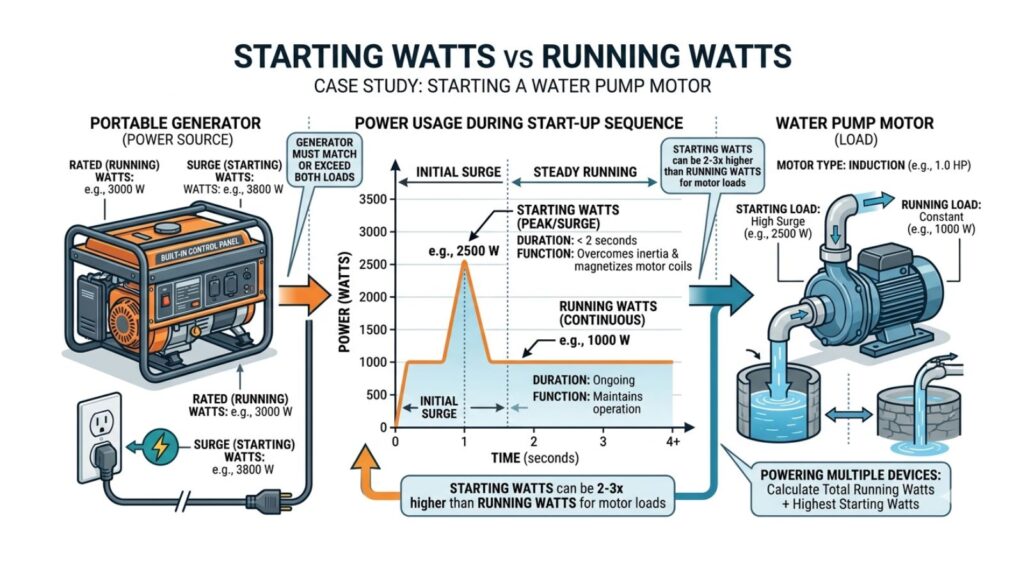
To size a generator correctly, you need to separate two different power conditions.
Running watts are the power required after the motor has started and reached stable operation. This is the continuous demand the generator must support for as long as the motor is running.
Starting watts are the temporary higher power demand during startup. This is the short burst that occurs when the motor first turns on.
Both matter, but starting watts often matter more when it comes to whether the system works at all.
Let us say you have a sump pump with a running power of 800 watts. If its starting demand is 2400 watts, then your generator must be able to handle that startup condition, not just the 800W running load. If you also have lights, a fridge, or other equipment connected at the same time, those loads must be added too.
That is why generator sizing for motors cannot be reduced to a simple one-line wattage comparison. You must look at the dynamic behavior of the load.
Why generators struggle with motor startup
A generator is not an infinite power source. It has limits in engine torque, alternator capacity, voltage regulation, and transient response. When a motor tries to start, it can pull a heavy current surge instantly. That sudden demand can cause the generator engine to slow down slightly, and the alternator voltage may dip before the system stabilizes.
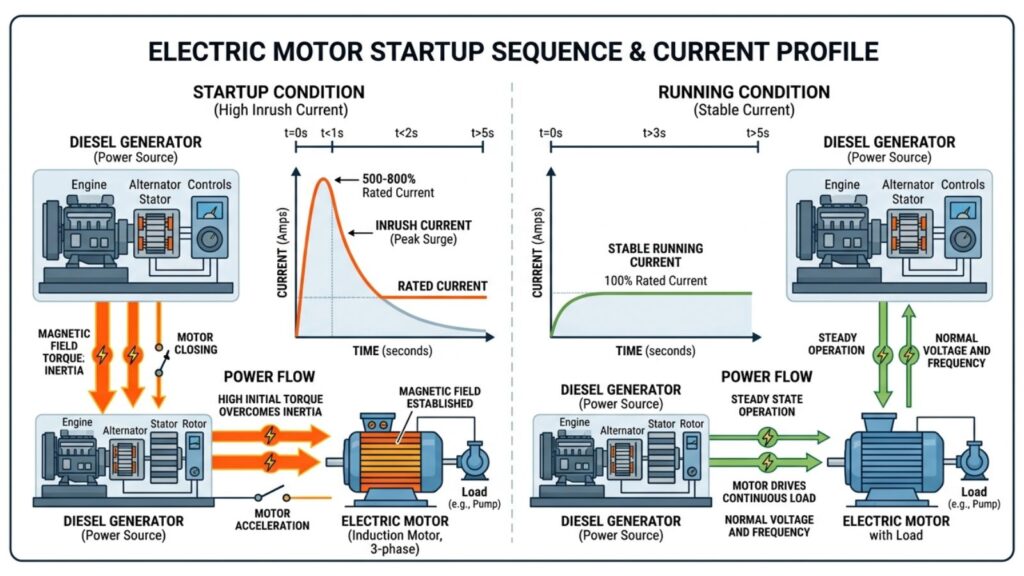
If the generator is well-sized, this dip remains within acceptable limits and the motor starts normally.
If the generator is undersized, one or more problems can happen. The motor may stall. The generator breaker may trip. Other connected devices may flicker or reset. Sensitive electronics may see poor voltage quality. In some cases, repeated hard starts can even shorten equipment life.
This is why good generator selection is not just about reaching the total watt number. It is also about making sure the generator can respond to starting surges without unacceptable voltage and frequency drop.
Common motor loads that cause generator sizing mistakes
In residential, commercial, and light industrial settings, a surprising number of loads include motors. People often forget that a system may be full of startup-heavy equipment even when the running power looks modest.
Water pumps are a classic example. A borewell pump, pressure pump, or sump pump may run at a manageable power level, but startup can be much harsher than expected. Refrigerators and freezers are another common example because compressor motors have startup characteristics that can catch homeowners off guard. Air conditioners also fall into this category, especially if they use conventional compressor starting rather than soft-start technology.
In workshops and job sites, air compressors, saws, grinders, and dust collection systems can be even more demanding. In agricultural applications, motor starting becomes even more critical because irrigation pumps and farm equipment often rely on generator backup in areas with unstable grid supply.
This is exactly why the keyword generator size for motor starting loads has such strong search intent. People are not just looking for theory. They are trying to solve a problem that shows up in real life, often after a generator has already disappointed them.
A practical way to calculate generator size for motor starting loads
The most reliable method is to identify both the running requirement and the starting requirement of the motor, then size the generator so it can handle the worst startup case while still supporting all other connected loads.
The process begins with gathering the motor data. Ideally, you want the rated voltage, running current, power factor if available, efficiency if available, and startup current or locked rotor current if the manufacturer provides it. In real-world field work, you will not always get perfect data, so practical estimation matters.
If the motor nameplate lists running current only, you can estimate running watts using:
Running Watts = Voltage × Current × Power Factor
For single-phase motors, this gives you a reasonable real-power estimate. For three-phase motors, the formula changes slightly, but the principle remains the same.
To estimate startup demand, you then apply a multiplier based on motor type and expected starting behavior. A common rule of thumb is that startup power may be 2 to 3 times running watts for easier starts, and 3 to 6 times or more for harder-starting motors. The exact value depends on design and load.
For practical generator sizing, it is often safer to think in terms of starting current rather than only watts, because generator voltage dip during motor starting depends strongly on that current surge. You can use engcal generator sizing calculator to avoid errors and save your time.
A real-world example that makes it clear
Let us take a simple example.
Imagine you have a 1 HP single-phase water pump. The running wattage may be around 750W to 1000W depending on motor efficiency and load conditions. A homeowner sees that number and assumes a 1500W generator should be enough.
But at startup, the pump may draw 3 to 4 times the running demand. Suddenly the generator may need to support 3000W or more for a brief moment. If other loads are already connected, such as lights, a refrigerator, or a control system, the required generator capacity climbs even higher.
Now suppose the generator is rated 1.5 kW continuous and 1.8 kW surge. On paper it looks close to the running load. In reality it may still fail to start the pump reliably.
That is the entire lesson in one example. Running watts alone are not enough because they ignore the most demanding moment in the motor’s operating cycle.
Why generator surge rating matters
Many portable and standby generators have two important ratings. One is the continuous or rated output, and the other is the surge or peak output. The surge rating reflects the generator’s ability to support short-duration overloads such as motor startup.
This surge capability is very important when sizing for motors. However, it should not be used blindly.
Some buyers assume that if the motor startup demand is below the published surge rating, everything will be fine. That is not always true. Generator surge ratings are often short-duration values under specific conditions, and actual performance may vary with temperature, altitude, engine speed response, and the presence of other loads.
Also, a generator may technically provide the wattage but still allow too much voltage drop during startup. Many motors can tolerate some voltage dip, but excessive drop can prevent smooth acceleration and create repeated restart attempts.
That is why experienced sizing always includes margin. You do not want the generator operating at the edge every time a motor starts.
The role of voltage dip in motor starting performance
This is a part many basic articles miss, but it matters a lot. During startup, a motor pulls heavy current, and that current causes a voltage drop across the source impedance. If the source is stiff, like a utility grid or a generously sized generator, the voltage dip may be small. If the source is weak, like an undersized portable generator, the voltage dip may be severe.
A low starting voltage means the motor develops less torque. Less torque means it takes longer to accelerate. A longer acceleration means the motor remains in high-current startup mode for longer. That in turn puts even more stress on the generator.
This becomes a bad cycle very quickly.
So generator sizing is not only about giving enough power in theory. It is also about making sure the source remains electrically strong enough to let the motor transition quickly from startup to stable running.
How much generator margin should you keep?
In practical engineering work, margin is everything. You do not size a generator exactly equal to the calculated worst-case demand unless you are comfortable with a fragile system. Real installations see voltage fluctuation, fuel quality issues, altitude effects, maintenance differences, and changes in load behavior over time.
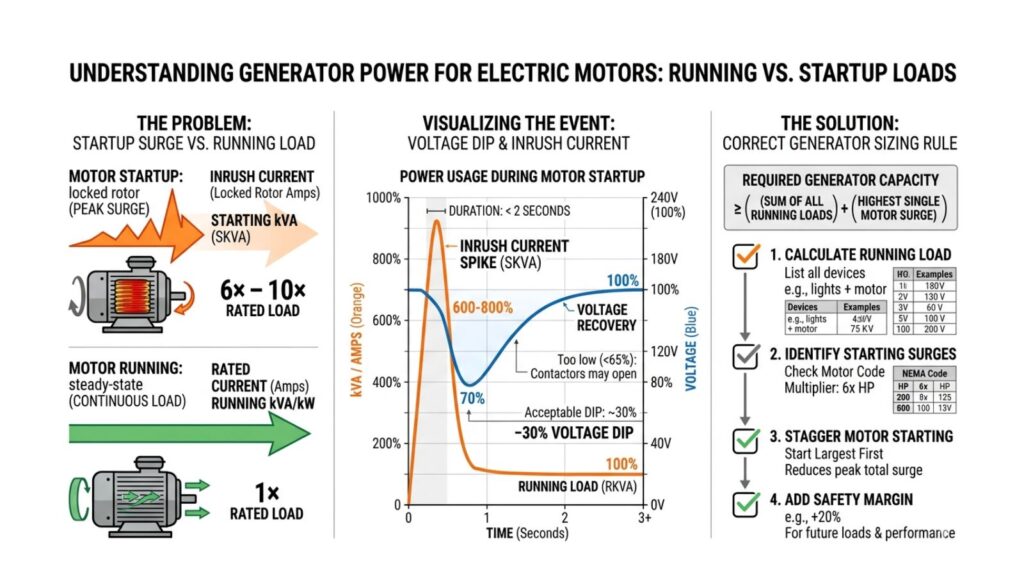
For motor starting loads, I generally recommend choosing a generator with enough headroom above both the continuous running load and the startup surge. The right margin depends on application, but conservative sizing almost always leads to more reliable operation.
If the generator will serve only one motor load occasionally, the margin can be smaller if data is solid and field conditions are controlled. But if the generator is supporting mixed household or site loads along with the motor, additional headroom is wise.
That extra breathing room improves voltage stability, reduces stress on the machine, and gives you a more dependable backup system.
Starting method makes a big difference
Not all motors start the same way, and this is another reason oversimplified generator charts can be misleading.
A direct-on-line start usually produces the highest inrush current because full voltage is applied immediately. This is common in many simple motor applications.
A soft starter reduces startup current by ramping the voltage more gradually. Variable frequency drives can reduce starting stress even further in some applications. Certain modern air conditioners and compressor systems use inverter-driven or soft-start technology, which changes generator sizing requirements significantly.
So when someone asks about generator size for motor starting loads, the correct answer always depends partly on how the motor starts. Two motors with the same running power can require very different generator sizes if one uses direct start and the other uses a soft-start approach.
This is why nameplate power alone is never the full story.
Why one motor starting at a time is often the best strategy
In larger systems with multiple motors, sequencing matters. If two or three motors try to start at the same instant, the required generator size increases dramatically. In many cases, a smart control strategy can reduce generator size by staggering startups.
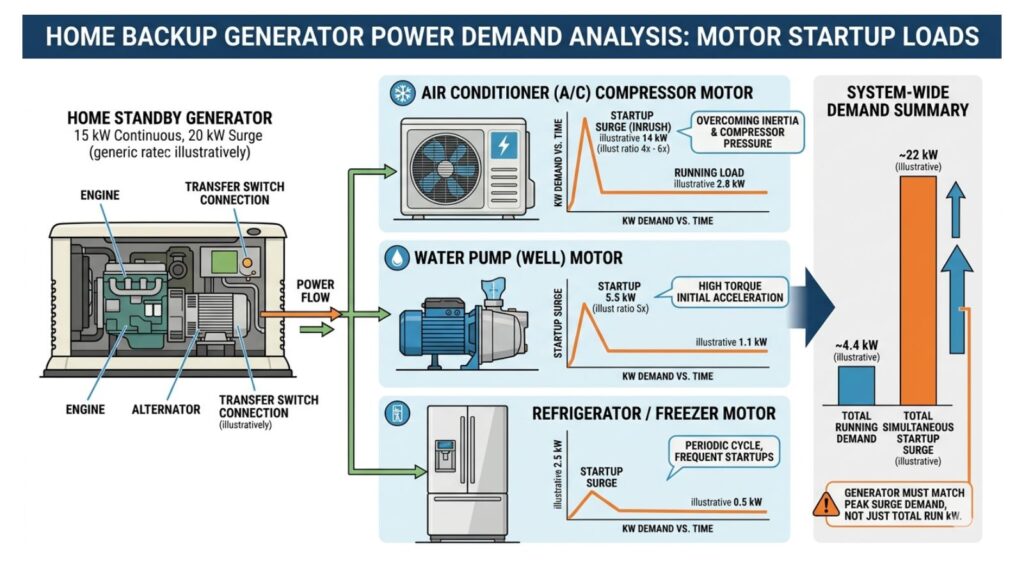
For example, in a pumping system, you may allow one motor to start and stabilize before the next one is energized. In a home backup system, you may delay refrigerator restart when a pump is already starting. In a workshop, you may avoid running an air compressor and a heavy saw startup at the same moment.
This kind of load management is one of the most cost-effective ways to improve generator performance without simply buying a much larger unit.
Common sizing mistakes to avoid
One mistake is using only running watts and ignoring startup demand completely. This is by far the most common problem.
Another is assuming that all generator watt ratings are directly comparable without checking surge capability and voltage regulation performance. Two generators with the same advertised wattage can behave very differently during motor startup.
A third mistake is forgetting about the rest of the system. The motor is not always the only load. Lighting, electronics, chargers, heaters, and control devices all add to the total load seen by the generator.
People also make the mistake of ignoring cable length, voltage drop, and environmental conditions. Long cable runs and poor connections can make startup even harder. High altitude can reduce generator engine output. Poor maintenance can also make a generator perform below nameplate expectations.
Real-world sizing is always a system decision, not just a label decision.
A practical engineer’s approach to generator selection
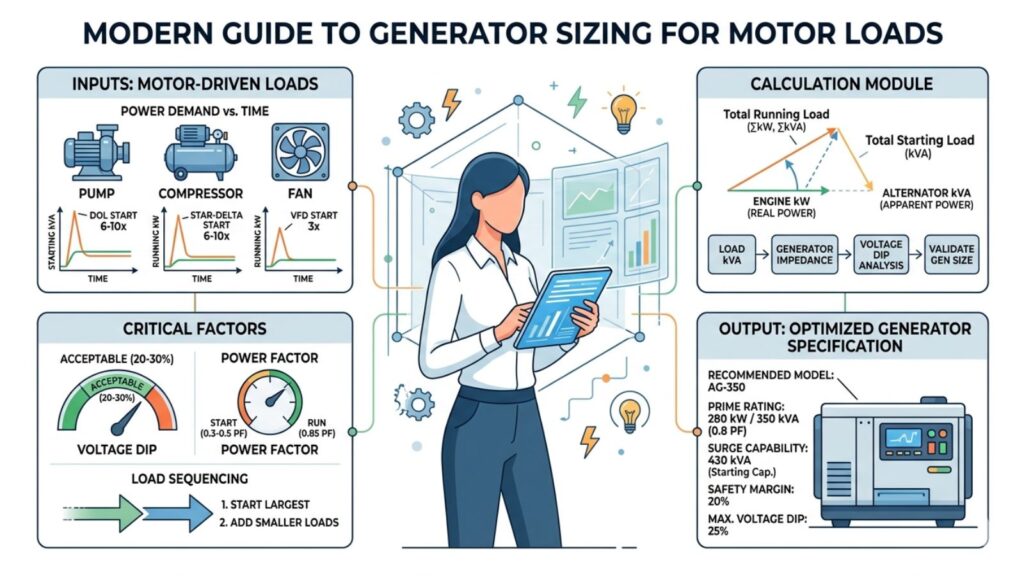
When I size a generator for motor-driven loads, I start with the motor’s actual application, not just the marketing label. I want to know whether the load is a pump, compressor, fan, or tool. I want to know whether it starts under load or no-load. I want to know whether the system can tolerate sequencing or whether it must start instantly. I also want to know what other loads will be operating at the same time.
Then I estimate the starting demand conservatively, not optimistically. I compare that to both the continuous and surge capabilities of the generator, while also thinking about voltage dip and future operating margin. If there is uncertainty, I size up rather than down.
That may sound cautious, but that is usually what delivers a generator setup that feels strong and dependable in the real world.
Final thoughts
If there is one thing to remember from this article, it is this: running watts do not tell the full story when motors are involved. A motor may look small once it is operating, but startup is where the real challenge lies. That short burst of high current is often the deciding factor in whether a generator performs well or struggles badly.
Choosing the right generator size for motor starting loads means understanding startup behavior, surge capacity, voltage dip, and real operating margin. It means looking beyond the simple watt number on the label and thinking like a system designer.
That is exactly how you avoid common mistakes, protect your equipment, and build a backup power setup that works when you actually need it.
If you are creating content around generators, backup power, UPS systems, or motor-driven loads, this topic is a strong authority piece because it solves a real problem people search for every day. And more importantly, it answers the question the right way.
FAQ: Generator Size for Motor Starting Loads
Why are running watts not enough for motor generator sizing?
Because motors draw much higher current during startup than during normal operation. The generator must handle that startup surge, not just the running power.
How much higher are starting watts than running watts?
It depends on the motor type and starting method. In many cases, starting demand may be 2 to 6 times the running wattage, and sometimes more.
What motor loads most often cause generator sizing issues?
Water pumps, refrigerators, air conditioners, air compressors, workshop tools, and other compressor or induction motor loads are common troublemakers.
Can generator surge rating handle motor startup?
Sometimes yes, but not always reliably. You must also consider voltage dip, other connected loads, and available headroom.
Is it better to oversize a generator for motor loads?
In most practical cases, some margin is a good idea. It improves startup performance, reduces stress, and provides more stable operation.