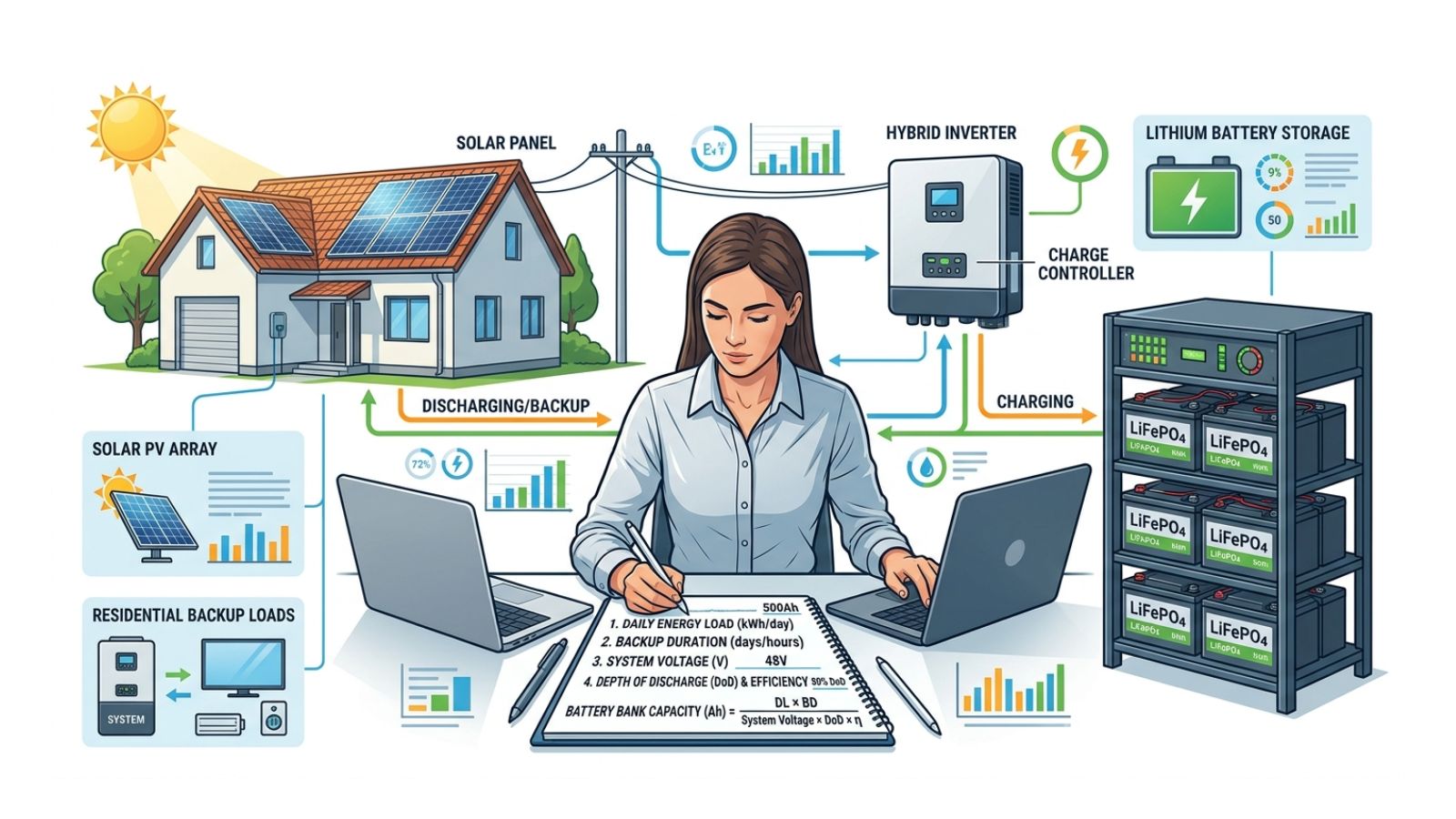

If you are planning a backup power system for your home, office, shop, or small facility, one of the most important questions you will face is this: how large should the battery bank be? This is where battery bank sizing for UPS and solar backup becomes a practical engineering decision, not just a product selection exercise.
Many people focus heavily on the inverter or solar panel side of the system, which is understandable. Those components are visible, easy to compare, and often marketed aggressively. But in real-world backup performance, the battery bank is what decides how long your system can actually support the loads you care about. A well-chosen battery bank gives confidence during outages. An undersized one creates frustration. An oversized one can waste money without delivering proportional value.
After working with backup systems for years, I have seen the same pattern repeatedly. People either estimate battery size based on guesswork, or they copy someone else’s setup without understanding whether it actually fits their own load and runtime requirement. That usually leads to one of two outcomes. Either the battery drains too quickly, or the system ends up larger and more expensive than it needed to be.
The good news is that battery bank sizing is not mysterious. Once you understand the relationship between load, runtime, battery voltage, usable depth of discharge, and system losses, the whole process becomes much more logical. In this guide, I will walk through the practical way to size a battery bank for both UPS backup and solar-supported backup. The goal here is not just theory. The goal is to help you size a system that works properly in real life.
Why battery bank sizing matters so much
A battery bank is the energy storage section of the system. It stores power so that your inverter can continue supplying AC electricity when grid power is unavailable or when solar production is low. In a UPS setup, the battery bank is what keeps essential loads alive during power cuts. In a solar backup system, it plays a slightly broader role because it may also store daytime solar energy for evening or overnight use.
That distinction matters, but the core sizing logic remains the same. Your battery bank must store enough usable energy to support the required loads for the required duration.
That sounds simple, but this is exactly where mistakes happen. Many users think a battery’s Ah rating alone tells them everything they need to know. It does not. A 100Ah battery at 12V is very different from a 100Ah battery bank at 48V. Battery chemistry matters too, because not all stored energy is safely usable. A lead-acid battery should not be treated the same way as a lithium battery when estimating real available capacity.
This is why good battery bank sizing starts with energy demand, not just battery labels.
The first step is always load calculation
Before talking about batteries, you need to know what the system is expected to power. This is the foundation of the entire calculation. If the load estimate is wrong, everything that follows will also be wrong.
In a UPS or solar backup setup, the right approach is to list the actual appliances or circuits you want to support during an outage or low-solar period. This usually includes essentials such as lights, fans, Wi-Fi router, television, laptop chargers, desktop computers, security systems, and in some cases a refrigerator or small pump.
The key is to focus on realistic use, not maximum theoretical use. A homeowner may have a connected load of 5 kW in the house, but during backup they may only need 600W to 1200W of essential loads. That difference has a huge effect on battery cost and system size.
Let us say a typical essential backup load looks like this:
- Four LED lights at 10W each gives 40W.
- Three ceiling fans at 70W each gives 210W.
- A Wi-Fi router adds 15W.
- A television adds 100W.
- Two laptop chargers add 120W.
- A refrigerator may add 150W average running load.
That brings the total to roughly 635W.
This kind of load estimate is much more useful than vague phrases like a few lights and fans. Good battery bank sizing for UPS and solar backup depends on actual watt numbers.
Backup time is what converts load into stored energy requirement
Once you know the load, the next question is how long the battery bank needs to support it. This is where many designs change dramatically.
A UPS system used only for short outages may need one to two hours of backup. A residential inverter backup system in an area with frequent load shedding may need four to eight hours. A solar backup system may need to support evening and night loads for ten to fourteen hours, depending on solar availability and whether the user wants partial or full overnight autonomy.
Let us use the earlier 635W example. If the target backup time is 4 hours, the energy requirement becomes:
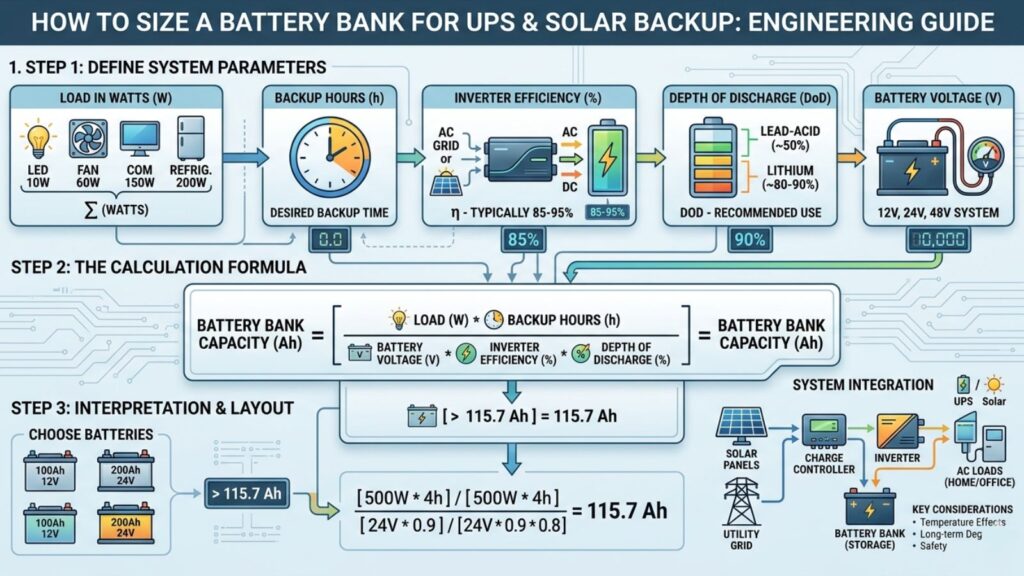
Energy Required = Load × Time
Energy Required = 635W × 4h = 2540Wh
So the battery bank must provide at least 2540 watt-hours of usable energy.
Notice the word usable. That is important. The total rated battery energy is not the same as the energy you should plan to use regularly. This is where battery chemistry enters the picture.
Why usable battery capacity matters more than rated capacity
One of the biggest errors in battery bank sizing is assuming that the full battery capacity is available every time. In practice, this is not how healthy battery systems are designed.
Lead-acid batteries, including tubular and AGM types, usually should not be discharged to 100% on a routine basis. Deep discharge shortens life significantly. For practical design, many engineers use 50% depth of discharge for long life or 70% to 80% in applications where more usable capacity is acceptable and battery replacement cycles are understood.
Lithium batteries behave differently. Many lithium iron phosphate systems allow 80% to 90% usable depth of discharge without the same life penalty seen in lead-acid batteries. That means two battery banks with the same nominal watt-hour rating can deliver very different practical usable energy.
Let us say you need 2540Wh of usable energy.
If you are using lead-acid batteries and designing around 50% depth of discharge, the total battery bank energy should be around:
2540Wh ÷ 0.50 = 5080Wh
If you are using lithium with 90% usable capacity, the required nominal battery bank energy becomes:
2540Wh ÷ 0.90 = 2822Wh
That difference is one of the reasons lithium systems can appear expensive upfront but more efficient in usable storage terms.
Inverter losses and system losses should never be ignored
Another common sizing mistake is forgetting that batteries supply DC power while most home and office loads consume AC power. That conversion happens through the inverter, and it is never perfectly efficient.
A good inverter may operate around 90% to 95% efficiency under appropriate loading conditions. Lower-quality systems may perform worse. In addition to inverter losses, wiring losses and battery charging-discharging inefficiencies also affect system performance.
For design purposes, it is wise to include a loss factor. If your load needs 2540Wh at the AC side, and the inverter efficiency is 90%, then the battery must actually deliver more energy:
Battery Energy Needed = AC Energy Required ÷ Inverter Efficiency
Battery Energy Needed = 2540Wh ÷ 0.90 = 2822Wh
Now apply usable depth of discharge.
For lead-acid at 50% depth of discharge:
2822Wh ÷ 0.50 = 5644Wh
For lithium at 90% usable capacity:
2822Wh ÷ 0.90 = 3136Wh
This is how practical battery bank sizing should be done. Start with the real AC load requirement, then account for conversion losses and usable discharge limits.
Battery bank voltage changes the physical design
Once you know the energy requirement in watt-hours, the next step is to choose the battery bank voltage. This depends on the inverter or UPS design. Common system voltages include 12V, 24V, 48V, and sometimes higher in larger solar systems.
This is where beginners often get confused. Battery voltage does not change the total energy requirement, but it changes how that energy is distributed in terms of current and ampere-hours.
The formula is simple:
Battery Capacity in Ah = Required Energy in Wh ÷ Battery Bank Voltage
Suppose you need a 5644Wh lead-acid bank.
At 12V, the required capacity is:
5644 ÷ 12 = 470Ah
At 24V:
5644 ÷ 24 = 235Ah
At 48V:
5644 ÷ 48 = 117.6Ah
The total stored energy is the same, but a higher system voltage reduces current. That generally improves efficiency, reduces cable size, and makes system design cleaner for medium and large backup systems.
In small home UPS setups, 12V and 24V are common. In larger solar backup systems, 48V is often the more practical choice.
How to size a battery bank for UPS backup
UPS battery bank sizing is usually more straightforward than solar battery sizing because the battery is mainly there for backup, not daily energy shifting. The main inputs are total supported load, target backup time, inverter efficiency, and battery chemistry.
Let us walk through a realistic home UPS example.
Assume essential backup load is 800W.
Required runtime is 5 hours.
Inverter efficiency is 90%.
Battery type is lead-acid.
Design depth of discharge is 50%.
System voltage is 24V.
First, calculate AC energy demand:
800 × 5 = 4000Wh
Now adjust for inverter efficiency:
4000 ÷ 0.90 = 4444Wh
Now adjust for battery depth of discharge:
4444 ÷ 0.50 = 8888Wh
Now convert to Ah at 24V:
8888 ÷ 24 = 370Ah
So a practical design would be around a 24V 400Ah battery bank, depending on available battery sizes and desired margin.
This is a much better result than simply guessing based on one or two battery ratings. It also gives the homeowner a clear picture of what kind of battery bank is actually needed to support 800W for 5 hours. Using battery bank sizing calculator helps you to verify your calculations.
How solar backup sizing adds another layer
Battery bank sizing for solar backup follows the same basic logic, but now you also need to think about daily energy use, solar charging conditions, and autonomy days.
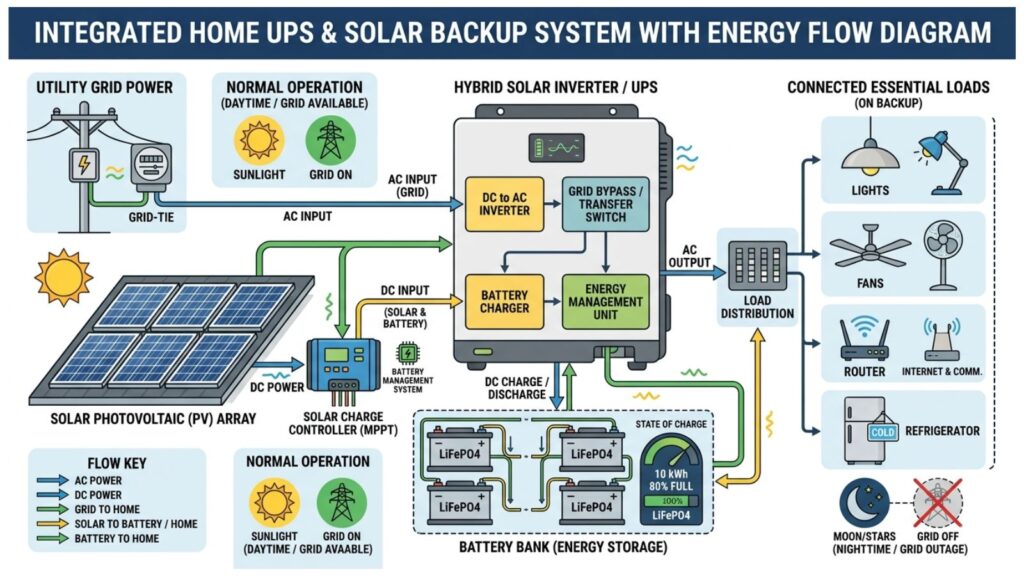
In a solar-supported system, the battery bank may not only cover outages. It may also store solar energy during the day and supply loads in the evening or overnight. If the site experiences cloudy weather or inconsistent solar production, battery autonomy becomes important.
Autonomy simply means how many days or hours the battery can support the load without sufficient charging input.
For example, let us say your night load is 500W for 10 hours. That gives:
500 × 10 = 5000Wh
If you want one full night of backup, that is your usable requirement. If you want one and a half days of autonomy because weather is uncertain, the battery bank must be larger.
Suppose the design target becomes 7500Wh usable energy. With a 48V lithium battery bank and 90% usable capacity:
7500 ÷ 0.90 = 8333Wh
8333 ÷ 48 = 173.6Ah
So a 48V 200Ah lithium battery bank would be a realistic design choice, giving some useful margin.
This is why solar battery sizing is often more strategic than UPS battery sizing. It must consider not just immediate backup hours, but also charging cycles, night consumption, and weather-related reliability.
Series and parallel battery connections must match the system voltage and capacity target
Once the voltage and Ah requirement are known, the battery bank has to be arranged physically using series and parallel connections.
Series connection increases voltage while keeping Ah the same. Parallel connection increases Ah while keeping voltage the same.
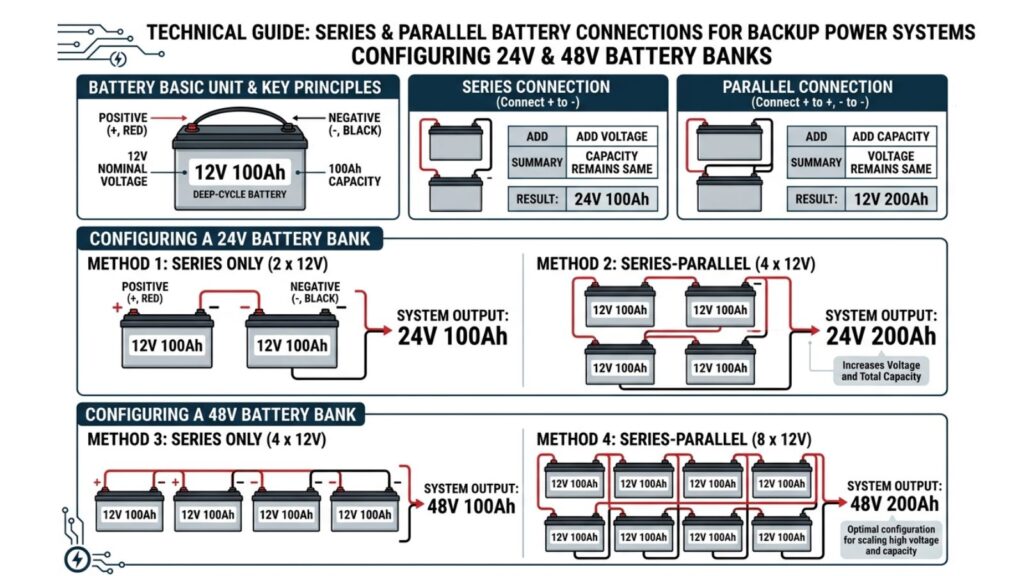
For example, if you are building a 24V battery bank using 12V 200Ah batteries, two batteries in series will give 24V 200Ah. If you need 24V 400Ah, you need two such series strings in parallel, for a total of four batteries.
If you are building a 48V bank using 12V 100Ah batteries, four batteries in series give 48V 100Ah. If you need 48V 200Ah, you will need two parallel strings of four batteries each, making eight batteries total.
This is basic battery bank architecture, but it matters because more parallel strings can increase balancing complexity, especially in lead-acid systems. In many cases, it is better to choose fewer strings with larger-capacity batteries rather than many small batteries in parallel.
Lead-acid vs lithium changes more than just chemistry
A lot of homeowners ask whether lead-acid and lithium can be sized the same way. The short answer is no, not exactly.
Lead-acid batteries are less efficient, heavier, larger, slower to charge, and less tolerant of deep cycling. They are still widely used because upfront cost is lower, and for many moderate backup applications they remain a practical option.
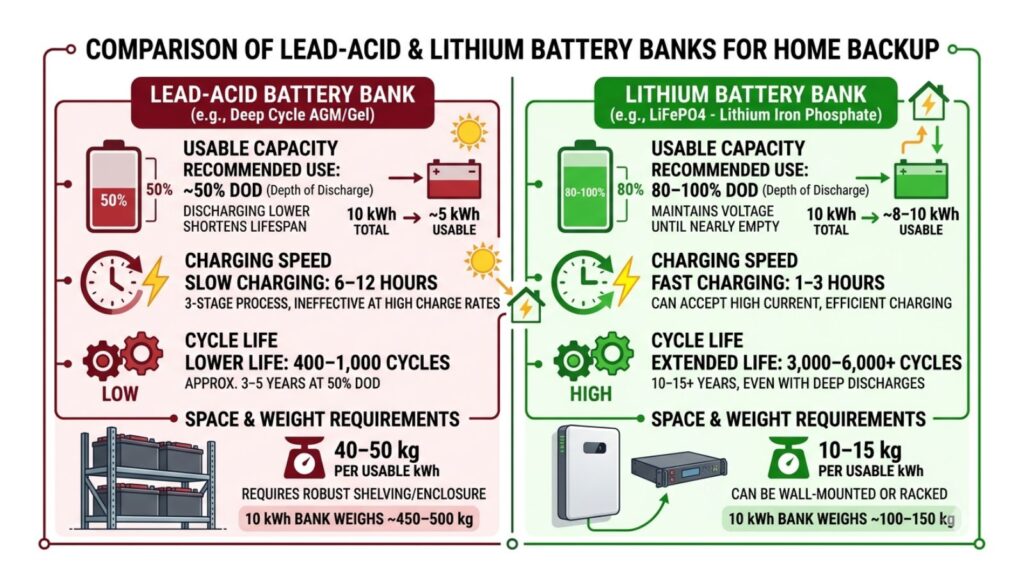
Lithium batteries are more compact, more efficient, faster charging, and better suited to deeper discharge. That usually means smaller nominal capacity is needed to achieve the same usable backup. However, cost, battery management system quality, and compatibility with the inverter must all be considered.
From a sizing standpoint, the main differences are usable depth of discharge and system efficiency. In real-world design, lithium usually delivers more effective energy per rated kWh than lead-acid.
That is why a direct Ah-to-Ah comparison between these technologies can be misleading. What matters is usable stored energy and long-term system performance.
Why future load growth should be part of the design
One of the most practical lessons I have learned in backup system design is this: today’s essential load often becomes tomorrow’s normal load.
A user may initially want the battery bank to support only lights, fans, and internet. A few months later they also want television, desktop computer, or a small refrigerator on backup. In solar systems, users often expand loads once they become comfortable with the idea of stored energy.
That is why battery bank sizing should leave some margin where budget allows. A system designed exactly at today’s minimum may feel restrictive later. Some growth margin helps the system remain useful as needs evolve.
This does not mean you should overspend blindly. It means you should design thoughtfully, especially if the inverter and charging system already allow expansion.
Common battery sizing mistakes to avoid
The most common mistake is sizing based on battery Ah alone without considering voltage. A 12V 200Ah bank and a 48V 200Ah bank are very different systems in terms of total energy.
Another major mistake is ignoring depth of discharge. If you size a lead-acid bank as though 100% of the energy is available every day, real backup time will be disappointing and battery life will suffer.
Many people also forget inverter losses. They calculate based on AC load but do not account for DC-side energy draw. That makes the battery bank appear larger on paper than it is in practice.
In solar systems, another mistake is failing to consider cloudy conditions or insufficient charging windows. A battery bank that looks adequate in perfect weather may feel undersized during consecutive low-sun days.
Then there is the very common issue of trying to back up too many non-essential loads. Good battery bank design begins with load discipline. If everything is considered essential, the battery bank quickly becomes expensive and impractical.
A practical engineer’s rule for battery bank sizing
When I size battery banks for UPS and solar backup, I prefer to use conservative, real-world numbers rather than optimistic brochure values. I would rather design a system that comfortably achieves the expected runtime than one that only works on paper under perfect conditions.
That means using realistic inverter efficiency, honest load estimates, healthy depth-of-discharge limits, and a sensible design margin. It also means asking the user one practical question: what loads truly matter when the grid goes down?
That question often simplifies the whole project. Once essential loads are separated from convenience loads, battery sizing becomes more accurate, more affordable, and much more useful.
A well-sized battery bank is not necessarily the biggest one. It is the one that matches the real application.
Final thoughts
Battery bank sizing for UPS and solar backup is one of the most valuable topics to understand if you want a dependable power system. It connects directly to runtime, reliability, cost, and user satisfaction. And unlike many flashy power-system topics, this one has very practical consequences. If the battery bank is too small, the system disappoints quickly. If it is thoughtfully sized, the whole backup experience feels stable and predictable.
The right way to size a battery bank starts with actual load in watts and required runtime in hours. From there, you account for inverter losses, battery depth of discharge, system voltage, and battery chemistry. That process gives you a much more trustworthy result than relying on guesswork or generic battery charts.
Whether you are planning a simple home UPS or a more complete solar backup system, the principle remains the same. Size the battery bank around usable energy, not label assumptions. That is how you build a system that performs well in the real world and supports the loads that matter when power is not available.
If your goal is to build topical authority in backup power, solar storage, inverters, and runtime planning, this is an excellent article topic because it answers a real buying and design question people search for every day.
FAQ: Battery Bank Sizing for UPS and Solar Backup
How do I calculate battery bank size for a UPS?
Start with the backup load in watts and multiply by the required runtime in hours. Then divide by inverter efficiency and allowable depth of discharge. Finally, convert the result from watt-hours into ampere-hours based on the battery bank voltage.
What is the best battery voltage for backup systems?
Small systems often use 12V or 24V, while larger UPS and solar backup systems commonly use 48V because higher voltage reduces current and improves wiring efficiency.
Can I use the full capacity of a battery bank?
Not usually. Lead-acid batteries should not be routinely discharged fully, while lithium batteries can generally use a higher percentage of their rated capacity safely.
Is lithium better than lead-acid for solar backup?
In many cases, yes. Lithium offers higher usable capacity, better efficiency, faster charging, and longer cycle life, though the upfront cost is usually higher.
Why does my battery bank deliver less backup time than expected?
Common reasons include higher actual load, inverter losses, battery aging, excessive depth of discharge, temperature effects, and unrealistic capacity assumptions during the original sizing.