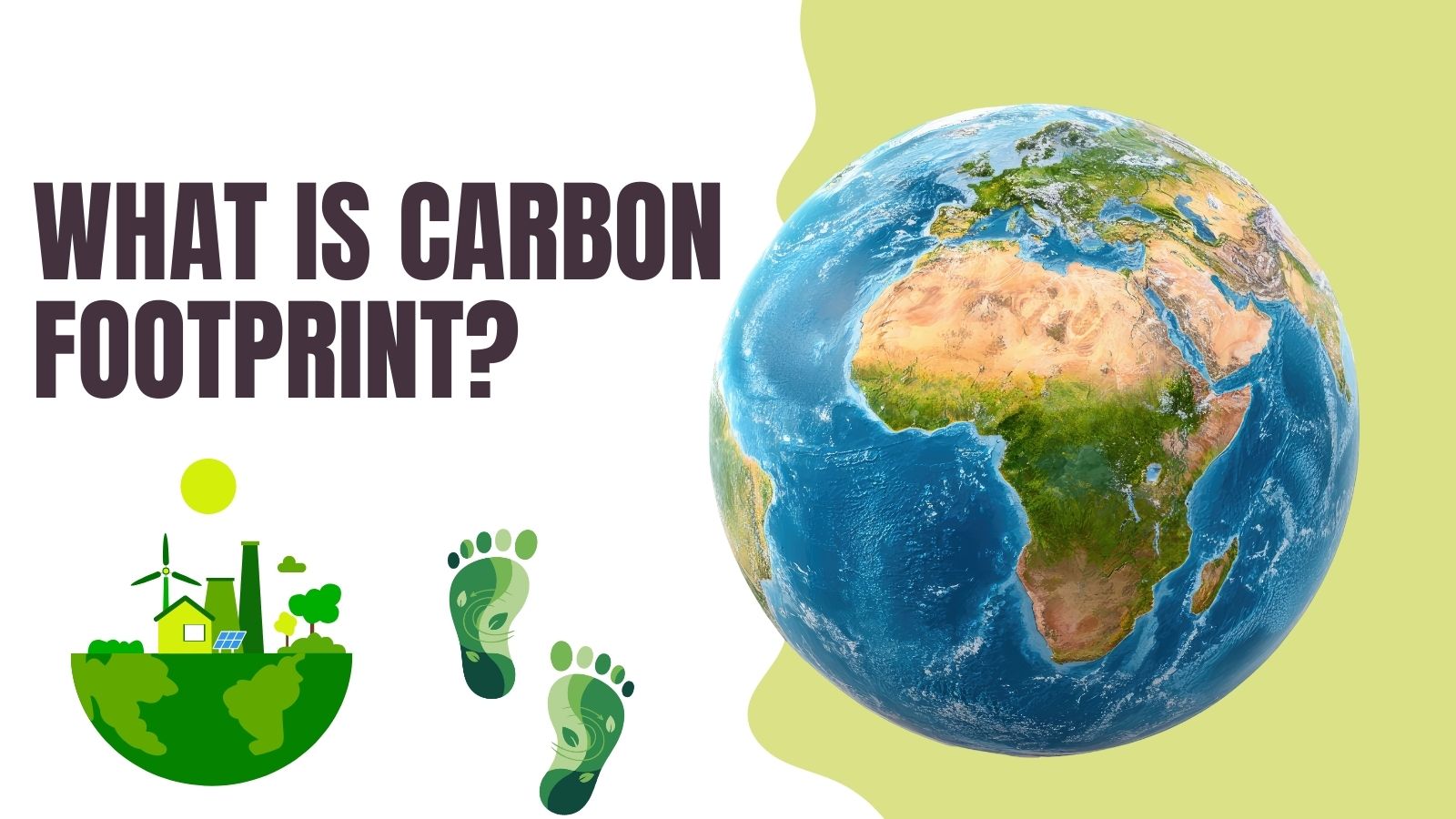

The term carbon footprint is used everywhere today, from climate discussions and corporate sustainability reports to classroom lectures and product labels. But many people still ask a very basic question: what is a carbon footprint, really? Is it just the smoke from factories? Is it only about cars and airplanes? Or is it a broader measure of how our daily activities affect the environment?
As an engineer, I like to explain it in practical terms. A carbon footprint is not just a slogan or a political talking point. It is a measurable way to estimate the impact that a person, product, company, service, or activity has on the atmosphere through greenhouse gas emissions. Once you understand it clearly, it becomes much easier to make better decisions in design, energy use, transportation, manufacturing, and even personal lifestyle choices.
In this article, I will explain what a carbon footprint means, how it is measured, where it comes from, why it matters, and what realistic steps can reduce it. My goal is to make the topic clear enough for students and useful enough for working professionals.
What is a carbon footprint?
A carbon footprint is the total amount of greenhouse gases released directly and indirectly by an individual, organization, event, product, or process. These emissions are usually expressed as carbon dioxide equivalent, written as CO2e.
That last part is important. Many people assume a carbon footprint only refers to carbon dioxide. In reality, other greenhouse gases such as methane and nitrous oxide also contribute to global warming. Since these gases trap heat differently, engineers and environmental analysts convert them into a common unit called carbon dioxide equivalent. This allows different gases to be compared on the same basis.
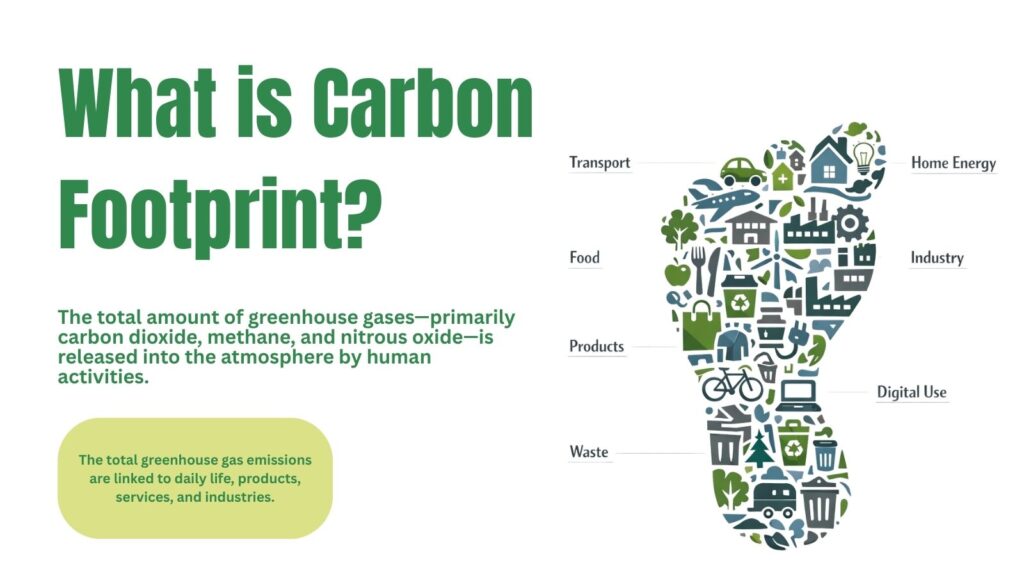
So, when we say that a household, factory, or product has a certain carbon footprint, we are talking about the total warming effect of all associated greenhouse gas emissions, expressed in a standardized form.
Why is it called a “footprint”?
The word “footprint” is used as a metaphor. Just as a footprint shows where someone has walked, a carbon footprint shows the environmental mark left behind by an activity or system. It helps answer a very practical question: how much climate impact is generated by what we do?
This impact can come from obvious sources, such as burning fuel in a vehicle, or from less visible sources, such as the electricity used by a data center, the production of steel in a building, or the transportation of food across long distances.
From an engineering perspective, the value of the carbon footprint concept is that it forces us to look at systems, not just isolated actions. A product may appear efficient during use, but the manufacturing stage may be highly energy-intensive. A building may look sustainable because it has solar panels, but the materials used in construction may carry significant embodied emissions. Good analysis always looks beyond the surface.
What causes a carbon footprint?
A carbon footprint comes from activities that release greenhouse gases into the atmosphere. In day-to-day life, the biggest contributors often include transportation, electricity use, heating and cooling, food consumption, and waste generation.
For example, when petrol or diesel is burned in a vehicle engine, carbon dioxide is released. When coal or natural gas is used to generate electricity, emissions occur at the power plant. When cement, steel, plastics, or fertilizers are produced, energy is consumed, and greenhouse gases are emitted during processing. Even food has a carbon footprint because farming, refrigeration, packaging, transport, and land use all require resources and energy.
Digital activities also have an environmental cost. People often assume that online services are “clean” because they are not physical in the traditional sense. But servers, cooling systems, communication networks, and electronic devices all consume electricity. The carbon footprint of digital systems depends heavily on how that electricity is generated and how efficiently the infrastructure is designed.
Direct and indirect emissions
One of the most useful ways to understand carbon footprints is to divide emissions into direct and indirect categories.
Direct emissions come from sources that are owned or controlled by the person or organization. If you burn fuel in your own car, generator, or boiler, those are direct emissions.
Indirect emissions happen elsewhere, but they are still caused by your demand or activity. If you use electricity at home, the emissions may occur at a distant power station, but they are still linked to your consumption. The same logic applies to purchased goods, transportation services, cloud computing, and supply chains.
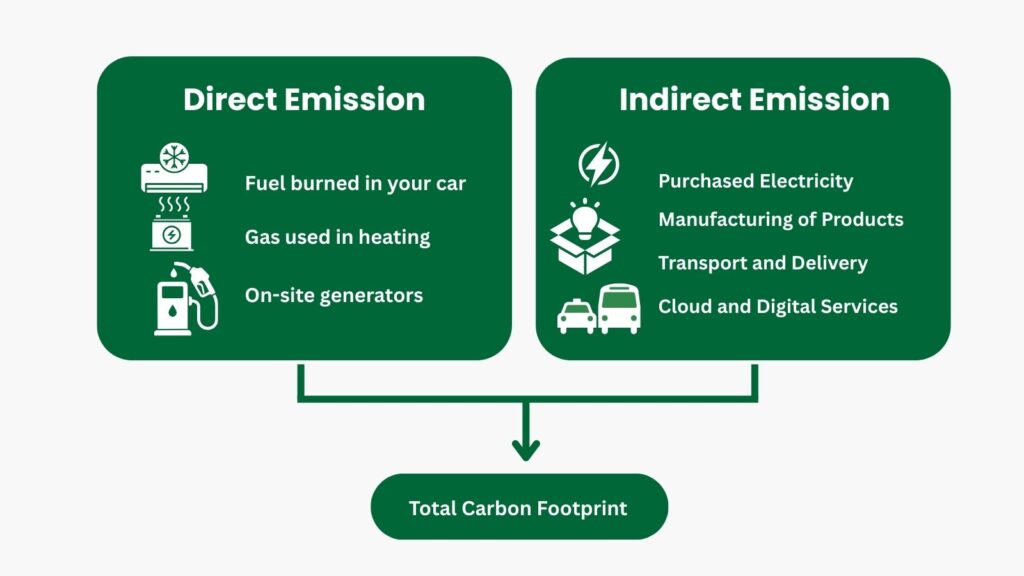
This distinction matters because indirect emissions dominate many real-world carbon footprints. A company may have a small office and low direct fuel use, yet a very large footprint through purchased materials, outsourced manufacturing, logistics, and product use.
Carbon footprint vs carbon emissions
These two terms are related, but they are not always used in the same way.
Carbon emissions usually refer to the actual release of greenhouse gases from a source. For example, a power plant emits carbon dioxide when fossil fuels are burned. Here you can instantly calculate the carbon emission from electricity.
A carbon footprint is a broader accounting concept. It includes emissions associated with an activity, person, or system, whether they occur directly or indirectly. In other words, emissions are the physical release, while the footprint is the measured total impact associated with a defined boundary.
As an engineer, I would say this is similar to the difference between a single measurement point and a system-level balance. One is the immediate output from a source. The other is the total impact assigned to a process or entity.
How is a carbon footprint measured?
Carbon footprints are usually measured in kilograms or tonnes of CO2e. The exact method depends on what is being assessed.
For an individual, the calculation may include household electricity, fuel use, flights, food consumption, and purchasing habits. For a company, it may include fuel, purchased electricity, supply chain activities, waste, employee travel, and product lifecycle impacts. For a product, analysts may assess raw materials, manufacturing, transport, usage, and end-of-life disposal.
The basic engineering approach is simple in principle. First, identify the activity data. That could be liters of fuel burned, kilowatt-hours of electricity used, or kilograms of material consumed. Then multiply that activity data by an appropriate emission factor. The result is the estimated greenhouse gas emission associated with that activity.
For example, if a machine consumes a known amount of electricity, and the electricity grid has a known emission factor, you can estimate the carbon footprint of operating that machine. If a fleet vehicle burns a known quantity of diesel, you can estimate the emissions based on diesel’s emission factor.
In practice, the challenge is not the formula. The challenge is setting correct boundaries, gathering reliable data, avoiding double-counting, and selecting credible emission factors.
Scope 1, Scope 2, and Scope 3 emissions
In business and industrial sustainability reporting, carbon footprints are often organized into three scopes.
Scope 1 covers direct emissions from owned or controlled sources. This includes fuel combustion in company vehicles, boilers, furnaces, and industrial processes.
Scope 2 covers indirect emissions from purchased electricity, steam, heating, or cooling. The emissions occur at the utility side, but they are associated with the organization’s energy demand.
Scope 3 includes all other indirect emissions in the value chain. This often includes purchased goods and services, transportation, waste, business travel, employee commuting, product use, and end-of-life treatment.
For many organizations, Scope 3 is the largest and most difficult category. It is also the one most commonly underestimated. From an engineering management perspective, Scope 3 is where system thinking becomes essential. You cannot improve what you do not map properly.
Examples of carbon footprints in everyday life
To make this topic more practical, let us look at some common examples.
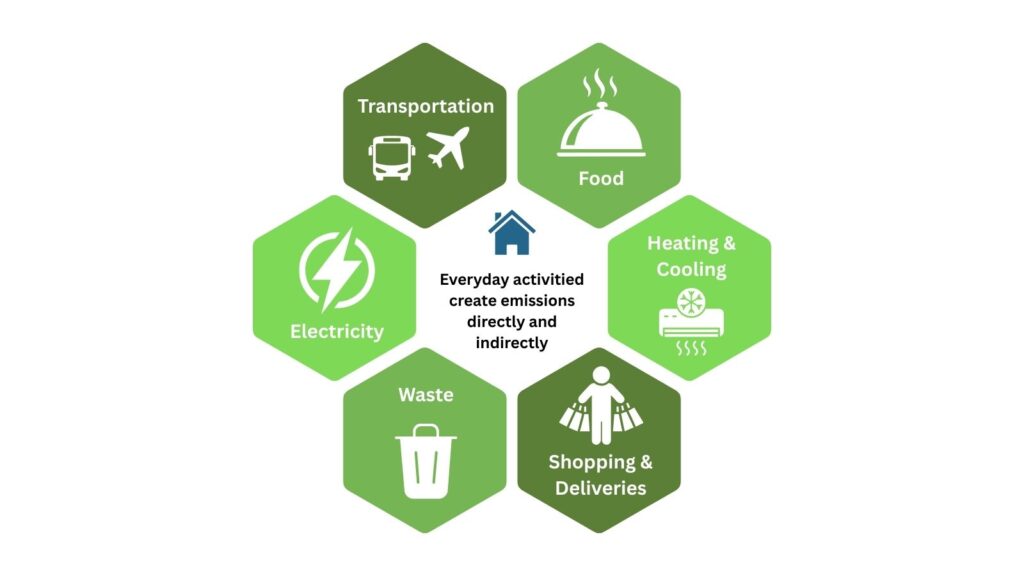
A person who drives long distances daily in a fuel-powered vehicle, lives in an air-conditioned home with inefficient insulation, takes multiple flights per year, and consumes a high volume of packaged goods will usually have a larger carbon footprint than someone who uses public transportation, lives in an energy-efficient home, and consumes fewer resource-intensive products.
A university campus may reduce its footprint by upgrading lighting systems, optimizing HVAC control, improving building insulation, installing solar systems, and electrifying campus transport. In this case, engineering design and operational control both matter.
A manufacturing plant may reduce emissions by improving process efficiency, recovering waste heat, switching to lower-carbon electricity, redesigning products to use less material, and shortening transport distances in the supply chain.
A product such as a reusable metal bottle may have a higher manufacturing footprint than a single plastic bottle, but over repeated use it may perform better overall. This is why lifecycle thinking is important. Looking only at one phase of a product can lead to poor conclusions.
Why carbon footprints matter
Carbon footprints matter because greenhouse gas emissions drive climate change, and climate change affects infrastructure, health, agriculture, water systems, energy demand, and industrial resilience.
This is not just an environmental concern. It is also a technical, economic, and risk-management issue. Engineers are already seeing the consequences through heat stress on equipment, changing cooling loads in buildings, grid instability, flood risk, supply chain disruptions, and new regulatory pressure.
For students, understanding carbon footprints builds environmental literacy and helps connect engineering decisions to real-world consequences. For professionals, carbon footprint analysis is becoming part of design practice, procurement, manufacturing strategy, ESG reporting, and regulatory compliance. For businesses, a carbon footprint is increasingly tied to brand trust, investor expectations, operational cost, and long-term competitiveness.
In simple terms, measuring a carbon footprint is not about assigning guilt. It is about identifying where impacts occur so better decisions can be made.
Common misconceptions about carbon footprints
One common misconception is that only large factories matter. In reality, emissions come from both large systems and millions of smaller decisions. Household energy use, transport choices, and consumption patterns all add up.
Another misconception is that carbon footprints are only relevant to environmental activists. That is no longer true. Today, carbon accounting is relevant to engineers, project managers, policy makers, product designers, architects, procurement teams, and financial analysts.
A third misconception is that reducing a carbon footprint means giving up comfort or productivity. Sometimes reduction does involve behavioral change, but in many cases it comes from better engineering. More efficient motors, improved controls, optimized logistics, cleaner grids, better insulation, and smarter material use can reduce emissions while also improving performance and lowering cost.
How to reduce a carbon footprint
Reducing a carbon footprint starts with identifying the biggest sources. This is where engineering logic is very useful. Instead of chasing symbolic actions, focus on high-impact areas first.
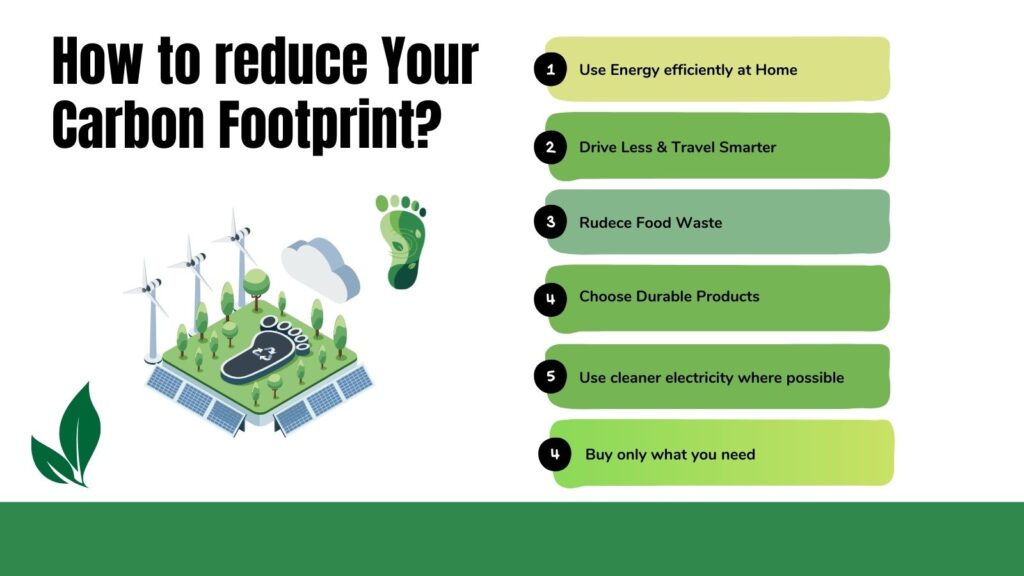
For individuals, transportation is often one of the most significant contributors. Driving less, carpooling, using public transport, switching to electric mobility where practical, and reducing unnecessary air travel can make a meaningful difference.
Electricity use is another major area. Efficient appliances, LED lighting, better insulation, smart temperature control, and renewable electricity options can all lower emissions. In warm climates, air conditioning efficiency matters a lot. Small improvements in building envelope design and thermostat settings can lead to large long-term savings.
Food choices also influence carbon footprints. Highly processed foods, excessive packaging, and resource-intensive agricultural products generally increase emissions. Reducing food waste is one of the most practical changes people can make because wasted food also means wasted land, water, energy, transport, and refrigeration.
For companies and institutions, the biggest gains often come from energy efficiency projects, electrification, cleaner electricity procurement, process optimization, supply chain engagement, and product redesign. Many of these are classic engineering improvement problems. The difference is that we now evaluate them not only for cost and performance, but also for emissions impact.
Carbon footprint of products and buildings
This is an area where engineers should pay special attention. Many people focus only on operational emissions, but embodied carbon is becoming increasingly important. Embodied carbon refers to the emissions associated with material extraction, manufacturing, transport, and construction before a building or product is even used.
For example, cement and steel are essential materials in modern infrastructure, but they also carry significant carbon impacts. In construction, a building with low operational energy but very high embodied carbon may not be as sustainable as it first appears.
The same applies to products. A device may consume little electricity in use, yet require energy-intensive materials, complex manufacturing, and global transport. Lifecycle analysis helps reveal these trade-offs.
This is where engineering judgment becomes critical. A good design decision is rarely based on one metric alone. We need to balance function, safety, cost, durability, maintainability, and environmental impact.
Can a carbon footprint ever be zero?
In theory, some activities can approach net-zero emissions, especially when powered by renewable energy and supported by low-carbon supply chains. In practice, achieving absolute zero is difficult because every system depends on materials, infrastructure, transport, and support services.
That is why many organizations talk about carbon reduction, carbon neutrality, or net-zero pathways rather than claiming that all emissions disappear completely. The priority should always be reducing real emissions at the source. Offsets should never be treated as a substitute for genuine efficiency and system improvement.
Final thoughts
So, what is a carbon footprint? It is the total greenhouse gas impact associated with a person, activity, product, service, or organization, expressed in carbon dioxide equivalent. It includes both direct and indirect emissions, and it gives us a way to measure climate impact in practical terms.
From an engineering point of view, the carbon footprint concept is useful because it turns a broad environmental problem into something we can analyze, compare, and improve. Once emissions are measured properly, they can be managed through better design, smarter operation, efficient energy use, cleaner materials, and stronger systems thinking.
For students, this topic builds a foundation for future work in energy, sustainability, manufacturing, infrastructure, and design. For professionals, it is already part of how modern engineering decisions are evaluated. And for businesses, it is becoming inseparable from performance, resilience, and credibility.
The most important takeaway is this: a carbon footprint is not just about blame. It is about visibility. When you can see where impacts come from, you can start reducing them in a meaningful and technically sound way.
FAQ Section
What is a carbon footprint in simple words?
A carbon footprint is the total amount of greenhouse gases produced by a person, activity, product, or organization. It shows how much that activity contributes to climate change.
Is the carbon footprint only about carbon dioxide?
No. It includes other greenhouse gases such as methane and nitrous oxide. These are converted into carbon dioxide equivalent so they can be compared together.
What are the biggest sources of carbon footprint?
The biggest sources often include transportation, electricity use, heating and cooling, industrial production, food systems, and supply chains.
How can a person reduce their carbon footprint?
A person can reduce their carbon footprint by using energy more efficiently, driving less, reducing flights, cutting food waste, and choosing lower-impact products and services.
Why do companies measure carbon footprints?
Companies measure carbon footprints to understand their environmental impact, improve efficiency, meet reporting requirements, reduce costs, and respond to customer and investor expectations.