
How to Size a Transformer for Commercial or Residential Loads
Transformer sizing looks easy when you first learn the formula. Multiply voltage by current, convert the result to kVA, and choose the next size up. That is the core method, and it is absolutely part of the job. But in real projects, transformer sizing is not just a calculator exercise. It is an engineering decision. You are not choosing a number for a worksheet. You are choosing a piece of equipment that has to carry the actual load, handle heat, support voltage needs, tolerate load variation, and still make sense a few years from now when the building changes. Industry guidance is very consistent on the foundation of the process: determine the required kVA from voltage and current, then select a transformer with a rating equal to or greater than the calculated load.
That is why good transformer sizing starts with a mindset, not a formula. The formula gives you the starting point. The real work is deciding what load the transformer will truly serve, what kind of environment it will operate in, and whether the installation is likely to grow. In residential work, that often means thinking ahead about EV charging, electric heating, workshop loads, or outbuildings. In commercial work, it often means mixed loads, longer run times, voltage sensitivity, and nonlinear equipment. A transformer that looks correct on paper can still be a poor choice if those realities are ignored. General-purpose dry-type transformers are designed for continuous operation at rated kVA, which is a reminder that the nameplate is meant to match real duty, not a guess.
The first rule: size the transformer in kVA, not just in kW
This is the most common place beginners go wrong. A transformer is sized by apparent power, which is kVA, not only by real power, which is kW. That difference matters because the transformer has to carry the voltage and current demanded by the load, not just the useful work output. Fluke’s power-factor guidance puts it clearly: power factor is the ratio of kW to kVA, and apparent power is found from voltage multiplied by current. In other words, if someone gives you only a kW number and no power-factor context, you may underestimate the transformer size.
In the field, this matters most when the load includes motors, compressors, mixed commercial equipment, or a lot of electronic power supplies. Two buildings can both show 40 kW of real load, but if one of them has a lower power factor, it may require more apparent power and therefore a larger transformer. That is why I always tell junior engineers the same thing: do not ask only how many kilowatts the building uses. Ask what voltage and current the transformer will actually be asked to deliver.
The basic transformer sizing formulas
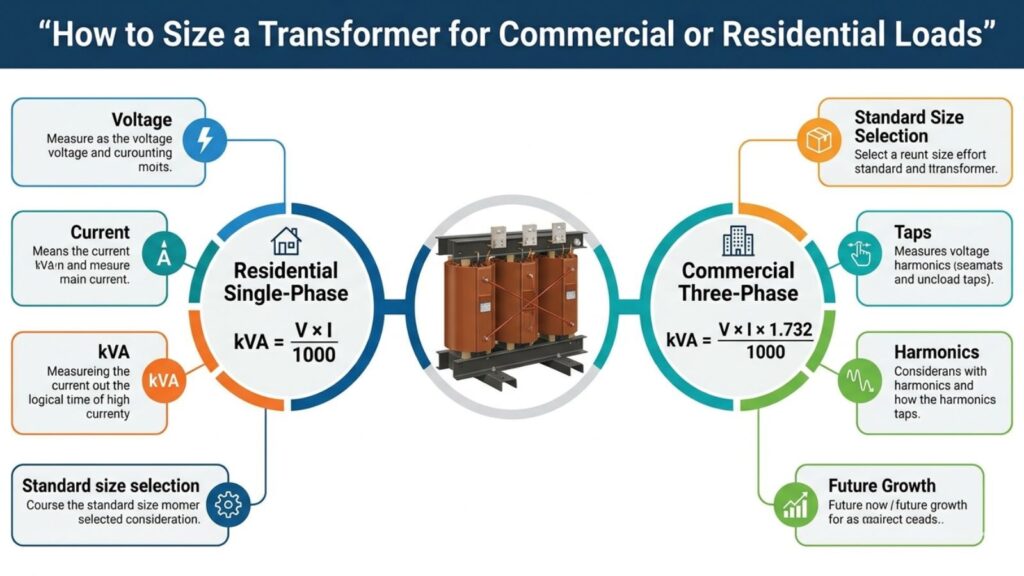
For a single-phase transformer, the starting formula is:
kVA = (V × I) / 1000
For a three-phase transformer, the standard formula is:
kVA = (V × I × 1.732) / 1000
That 1.732 is the square root of 3, which appears in three-phase power relationships. These formulas are standard across manufacturer sizing guides and technical references. After calculating the load kVA, the next step is to choose a transformer rating equal to or greater than that value.
That part is straightforward. The more important question is what numbers you put into the formula.
Use the real expected load, not a lazy guess
A transformer should be sized from the maximum expected operating load, not from a random guess and not from a worst-case fantasy where every possible connected device runs at full nameplate at the same moment forever. Good sizing depends on realistic demand.
For a residential installation, that could mean a subpanel feeding a garage, a detached workshop, a guest house, or a home with growing electric loads. For a commercial installation, it might mean a lighting panel, a retail floor, a small office distribution panel, a mechanical load center, or a mixed-use branch panel. The right current value is the current the transformer is actually expected to support at peak operating conditions, not the most dramatic number you can write down. Manufacturer sizing guides frame the calculation around maximum load current, which is the right practical approach.
This is one reason experience matters. I have seen projects where someone added up connected loads mechanically and oversized the transformer badly. I have also seen the opposite, where someone used a load value that looked neat on paper but ignored likely future demand. Both errors cost money. One wastes capital upfront. The other creates headaches later.
Residential transformer sizing is often simpler, but future growth matters more than people think
Residential transformer sizing is usually more straightforward because the loads are often single-phase and easier to understand. But that does not mean it should be taken lightly. A lot of residential transformer jobs fail because the initial load looks modest, then the property adds an EV charger, electric water heater, mini-split system, or shop equipment a year later.
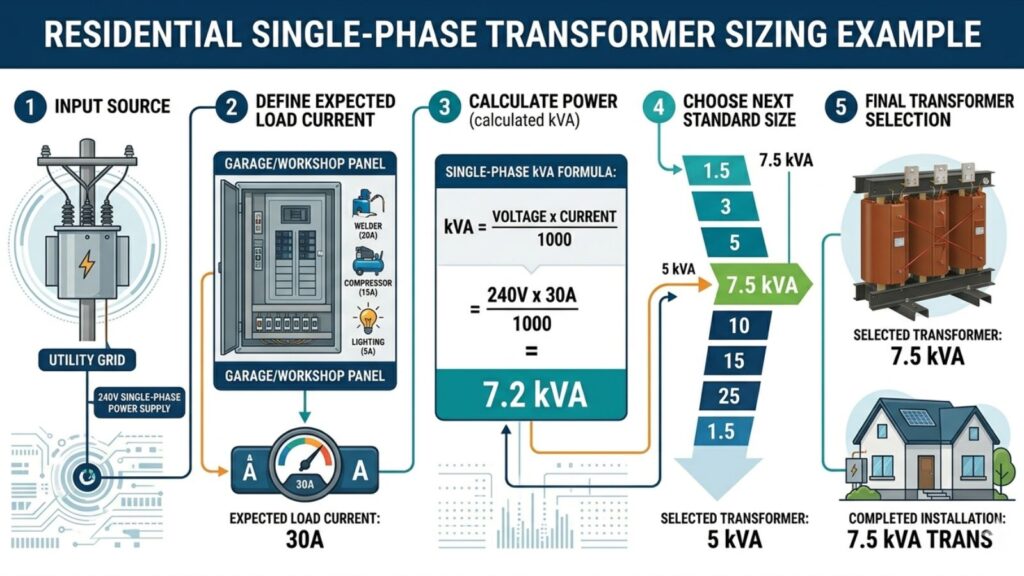
If you are sizing for a home-related application, the first questions should be practical. What is the supply voltage? Is the load single-phase? What is the maximum expected current? Is the transformer feeding a stable load or an evolving one? A transformer that looks comfortably sized for today’s garage may feel very small after that same space becomes a workshop with a compressor, welder, and battery charger.
So in residential work, I tend to be conservative in a sensible way. I do not oversize blindly, but I do respect growth. A transformer is not something most homeowners want to replace twice.
Commercial transformer sizing needs a wider view
Commercial transformer sizing uses the same formulas, but the decision is usually more layered. Commercial loads are often mixed. You might have lighting, receptacles, HVAC, refrigeration, office equipment, server loads, or small motors on the same downstream system. Even if the arithmetic says one size works, the operating profile may push you toward the next standard size for better thermal performance and future flexibility.
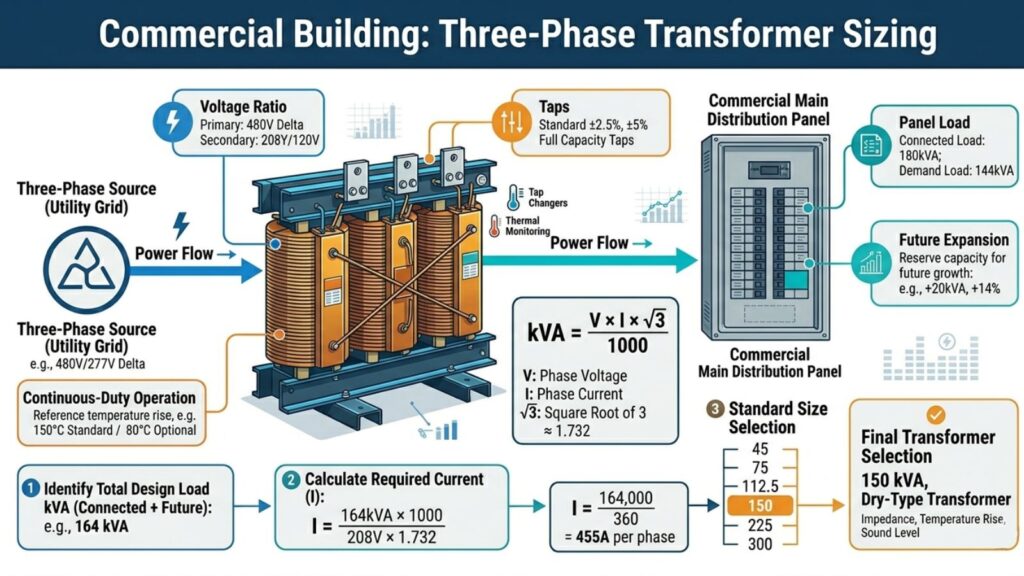
This is also where voltage sensitivity becomes more important. Commercial tenants and equipment tend to be less forgiving than simple residential loads. If the transformer is not matched properly to the expected demand, the result may not be an immediate failure. It may be nuisance problems. Heat, voltage drop, poor regulation under load, or limited expansion room often show up before outright overload. That is why transformer sizing in commercial work should be treated as part of the overall system design, not a standalone math problem. General-purpose dry-type transformers are sold in a wide range of primary and secondary voltage combinations, specifically because real installations need more than just the correct kVA number.
A practical step-by-step method
The cleanest way to size a transformer is to walk through the process in order.
- First, identify whether the load is single-phase or three-phase.
- Second, confirm the primary and secondary voltages you need.
- Third, determine the maximum expected operating current or load demand.
- Fourth, calculate the required kVA using the proper formula.
- Fifth, choose the next standard transformer size that is equal to or greater than the calculated value.
- Sixth, check whether taps, future expansion, harmonic content, temperature rise, and installation conditions justify a different selection.
That sequence sounds simple because it is. The value is in doing each step honestly. The industry guidance behind transformer sizing is consistent on this exact logic, even when the specific catalog or product line differs.
Residential worked example
Let us take a simple residential example.
Suppose you need a single-phase transformer for a 240 V load, and your calculated maximum load current is 80 A.
Using the formula:
kVA = (240 × 80) / 1000 = 19.2 kVA
That means the load requirement is 19.2 kVA. In the real world, you do not buy a 19.2 kVA transformer. You move to the next standard size above it. If you check common low-voltage transformer size tables from manufacturers such as Schneider, standard single-phase sizes include steps like 15 kVA, 25 kVA, 37.5 kVA, 50 kVA, and so on. So in this case, the logical choice is 25 kVA.
Now the engineering judgment comes in. If that load is fixed and unlikely to grow, 25 kVA may be the right answer. If the owner is likely to add more equipment later, you may want to think beyond the bare minimum. The formula gives you the minimum acceptable class size. The design decision tells you whether that is enough for the real job.
Commercial worked example
Now, take a commercial example.
Assume you are feeding a 208 V three-phase panel, and the expected maximum load current is 150 A.
Using the three-phase formula:
kVA = (208 × 150 × 1.732) / 1000 ≈ 54.0 kVA
So the calculated requirement is about 54 kVA. Again, that is not normally a standard catalog size. If you look at typical three-phase dry-type transformer size steps from major manufacturers, common sizes include 30 kVA, 45 kVA, 75 kVA, 112.5 kVA, and higher. Since 45 kVA is too small, you move up to 75 kVA. That is the correct practical selection from a standard product range.
This is where many people get uncomfortable because the jump from 54 to 75 feels large. But that is how real equipment selection works. Transformers are made in standard ratings, not in every possible calculated value. Once the load exceeds one standard step, you move to the next available size. Here you can calculate the transformer efficiency accurately using the Engal transformer efficiency calculator.
Voltage ratio matters just as much as kVA
It is possible to choose the right kVA and still choose the wrong transformer.
A transformer is not only a capacity device. It is also a voltage-conversion device. So the primary and secondary ratings must match the installation. A commercial transformer might need to step from a building distribution voltage to a lower panel voltage. A residential application might need a different single-phase arrangement. The point is simple: correct kVA with the wrong voltage ratio is still the wrong equipment. Dry-type transformer product guides emphasize the wide variety of primary and secondary voltage combinations available for exactly this reason.
Do not ignore taps
This detail gets overlooked more often than it should.
Transformer taps exist so the installer can match the input voltage more accurately to the actual system voltage and maintain proper secondary voltage. NEMA’s dry-type transformer purchasing guide explains that taps are used to match transformer input voltage with system voltage so the secondary stays where it should. It also notes common tap arrangements such as adjustments above and below nominal voltage, often in 2.5% steps.
That matters because buildings do not always receive perfect nominal voltage. If the incoming voltage runs consistently high or low and the taps are ignored, the downstream voltage may sit outside the range your equipment really wants. So when I size a transformer, I do not stop at kVA. I also ask whether voltage adjustment flexibility matters for this installation.
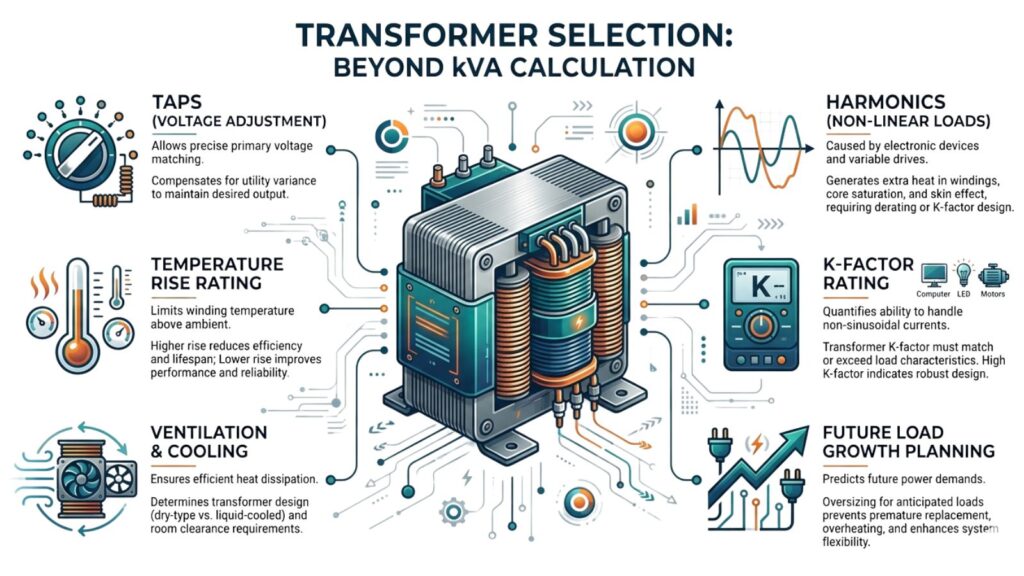
Continuous duty, heat, and installation environment
A transformer may be correctly sized electrically and still be a poor fit thermally. General-purpose dry-type transformers are designed for continuous operation at rated kVA, but that assumes normal installation conditions and proper ventilation. Published product guides also show different temperature-rise options, enclosure options, and mounting limits, which tells you something important: thermal behavior is part of transformer selection, not an afterthought.
In practice, I do not like sizing too close to the edge if the transformer will operate in a warm electrical room, a cramped utility space, or a location where airflow is limited. A transformer that works mathematically can still live a hard life if the environment is poor. That is one reason experienced engineers often leave sensible headroom instead of chasing the smallest possible acceptable size.
Harmonics can change the answer in commercial spaces
This is especially important in modern commercial systems.
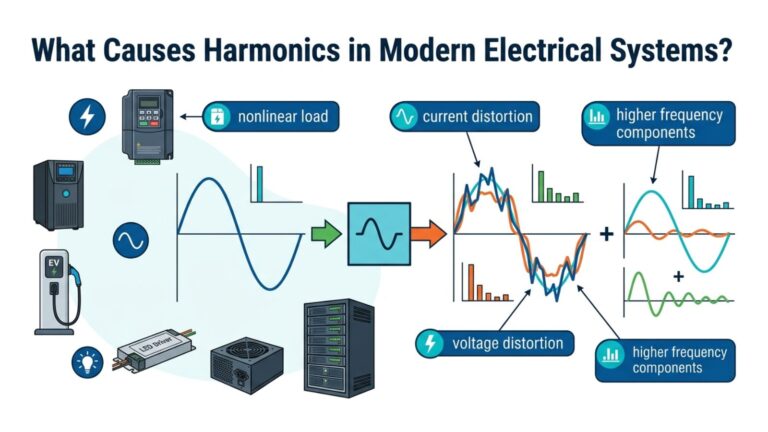
If the transformer will serve nonlinear loads such as LED lighting, servers, UPS equipment, variable frequency drives, or dense electronic power supplies, harmonics deserve attention. K-factor transformer guidance from ABB and Eaton explains that K-rated transformers are intended to withstand the additional heating caused by harmonic currents from nonlinear loads. Schneider makes the same basic point in its own K-factor explanation. The key idea is that the K-factor relates to the transformer’s ability to handle harmonic heating. It does not mean the transformer magically removes harmonics from the system.
So if you are sizing a transformer for a simple residential subpanel, a standard general-purpose unit is often appropriate. If you are sizing for an office floor, IT space, or a commercial panel rich in electronic loads, the harmonic environment may justify a different transformer type or at least a more careful review. That is not overengineering. It is a responsible design.
Common mistakes to avoid
The first mistake is sizing from kW alone and forgetting kVA. The transformer sees apparent power, not only real power
The second mistake is using connected load with no judgment. Nameplate totals are not the same as real maximum operating demand.
The third mistake is selecting the exact calculated value instead of moving to the next standard size. In actual product lines, you work with standard kVA steps.
The fourth mistake is ignoring taps and then wondering why the secondary voltage is not where it should be.
The fifth mistake is forgetting harmonics in commercial applications full of nonlinear loads.
Final takeaway
If you want the shortest correct answer to transformer sizing, it is this: calculate the required kVA from voltage and current, then choose the next standard transformer size above that value. That is the basic rule, and it is sound. If you want the answer that actually works in the field, go one step further. Make sure the load is realistic. Check the voltage ratio. Think about future expansion. Do not ignore taps. Pay attention to heat and installation conditions. And if the load is rich in power electronics, take harmonics seriously. That is how you size a transformer like an engineer, not like someone filling in a form.