


Electrical engineering feels far less “mystical” once you can estimate what a circuit will draw, what it will cost to run, and how long a battery will last. That is exactly what electrical energy and power calculations give you: a clear way to connect voltage, current, resistance, time, and real-world consumption. If you can do these calculations confidently, you’ll troubleshoot faster, design with fewer surprises, and understand electricity bills without guessing.
You’ll learn the difference between power and energy, the formulas engineers rely on, how kWh works, how to estimate appliance and battery usage, and how to avoid common mistakes that cause wrong answers. Throughout, the focus is on clarity and practical thinking. Because the best learning happens when the numbers feel meaningful.
What is the difference between Power and Energy?
People often use “power” and “energy” as if they mean the same thing, but in engineering, they describe different things.
Power is the rate at which energy is used. It answers: “How fast is electricity being used right now?” Power is measured in watts (W).
Energy is the total amount of power used over time. It answers: “How much electricity was used during a period?” Energy is commonly measured in watt-hours (Wh) or kilowatt-hours (kWh).
If you remember one line, remember this: power is “how fast,” energy is “how much over time.” This single idea prevents most beginner mistakes in electrical energy and power calculations.
What “Watts” Actually Mean? – Electrical Power
When an appliance is labeled 1000 W, it does not mean it “contains” 1000 watts. It means the appliance consumes energy at a rate of 1000 joules per second while operating.
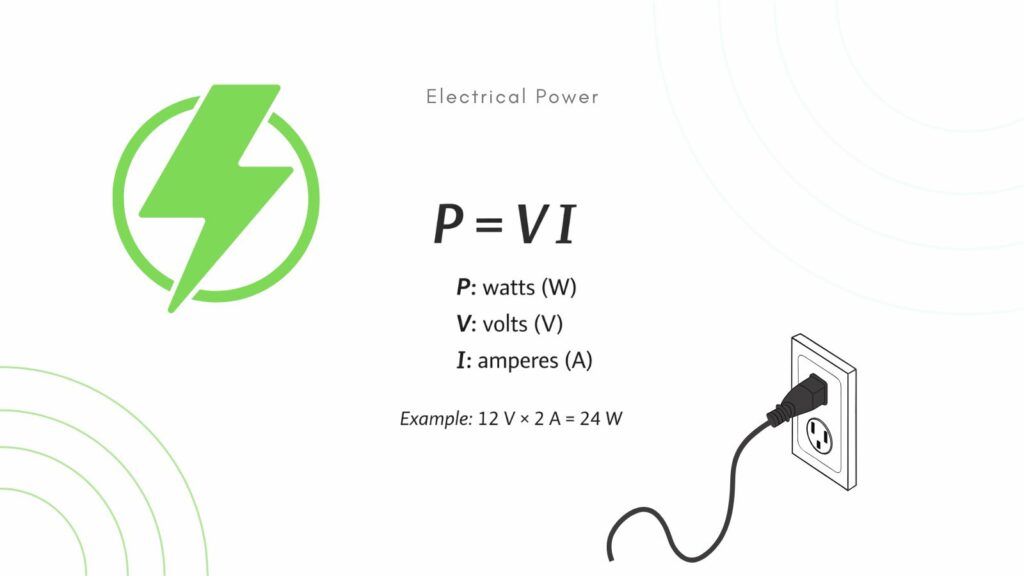
That is why high-wattage appliances like kettles and irons heat quickly: they convert electrical energy to heat fast. Low-wattage devices like phone chargers consume energy more slowly, so their total cost is usually small unless they run for many hours.
In engineering work, thinking of watts as a rate keeps your reasoning clean. It also makes your estimates sharper when doing electrical energy and power calculations for real loads.
Why Bills Use kWh? – Electrical Energy
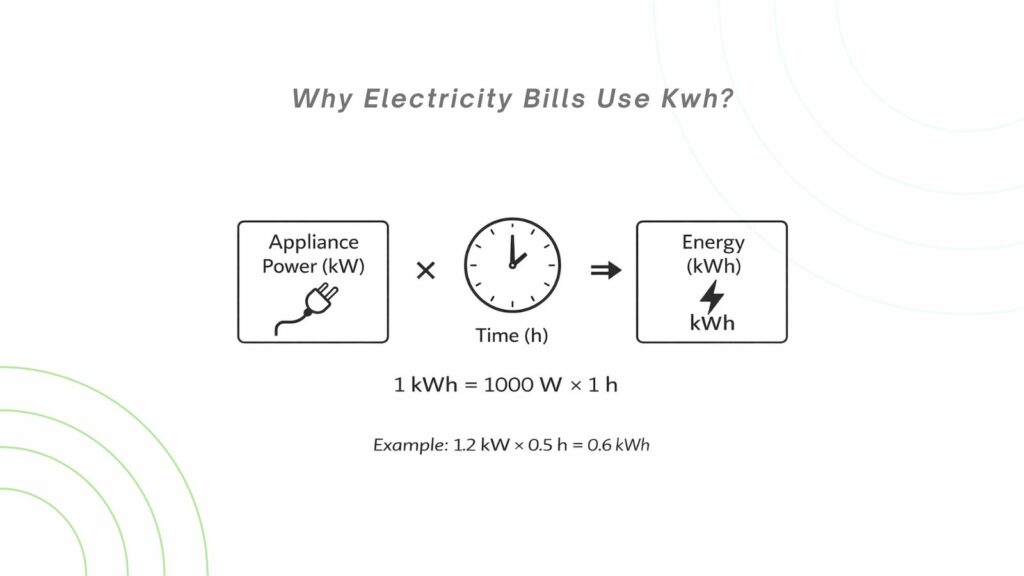
Electricity providers charge you for energy, not power, because energy represents total usage over time. A short burst of high power may use little energy, while a low-power device running all day can use a lot.
The billing unit is kWh because joules are too small for household-scale billing. A kilowatt-hour is simply energy:
1kWh = 1000W x 1h
This definition will appear again and again in electrical energy and power calculations related to home usage, appliance scheduling, and monthly estimates.
The Core Formulas You Must Know
Most practical problems reduce to a small set of formulas. When you master these, you can solve a surprising range of questions.
Electrical power from voltage and current
P = V x I
Where P is power in watts, V is voltage in volts, and I is current in amps.
Electrical energy from power and time
E = P x t
Where E is energy. If P is in watts and is in hours, then E is in watt-hours.
Engineers often say, “Find power first, then multiply by time.” That is the most reliable workflow for electrical energy and power calculations.
Power Formulas Using Resistance (Very Useful in DC Circuits)
In DC circuits, resistance-based calculations are common. By using Ohm’s Law, you can rewrite power in two additional forms that are especially useful for resistors and heating:
P = I x I x R
These help you answer questions like: “Will this resistor burn?” or “How much heat is this part dissipating?” If you want your electrical energy and power calculations to feel like real engineering, include power rating checks before building anything.
Worked Example: Power from Voltage and Current
Let’s take a practical example you’ll see in labs and datasheets.
A device runs on 12 V and draws 2 A. Its power is:
P=VI
=12 x 2 = 24W
Now, suppose it runs for 3 hours. Energy is:
E= P x t
=24 x 3 = 72Wh
Convert to kWh:
72Wh = 0.072 kWh
This is a complete “power to energy” chain, one of the most common electrical energy and power calculations you’ll do.
kWh Calculation: The Fast Method for Appliances
To compute energy consumption in kWh:
- Convert watts to kilowatts
P (kW) = P (W) / 1000
- Multiply by time in hours
E (kWh) = P (kW) x t (h)
Example: a 1200 W iron used for 30 minutes.
Power in kW:
P = 1200 / 1000 = 1.2 kW
Time in hours:
t = 0.5h
Energy:
E = 1.2 x 0.5 = 0.6 kWh
Notice how simple it becomes once your units are clean. This method is the heart of household electrical energy and power calculations.
Daily Energy Consumption: A Realistic Home Example
A powerful way to keep readers engaged is to show how small daily decisions add up. Here is a realistic mini-example:
A 10 W LED bulb used 6 hours/day:
E = 10 x 6 = 60 Wh
A 60 W fan used 8 hours/day:
E = 60 x 8 = 480 Wh
A 100 W TV used 4 hours/day:
E= 100 x 4 = 400 Wh
Total:
Total Energy = 60 + 480 + 400 = 940 Wh = 0.94 kWh
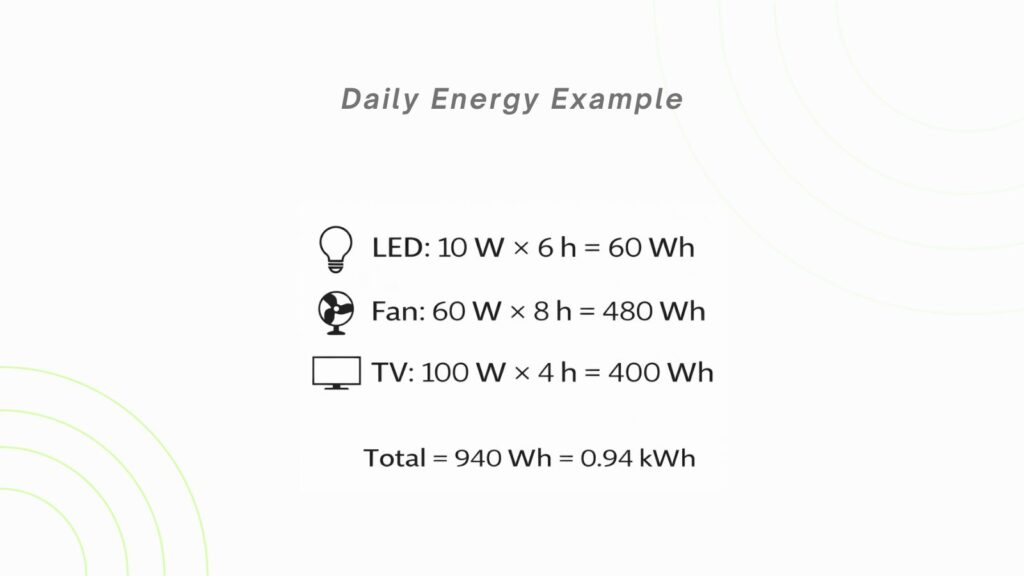
This kind of step-by-step breakdown makes electrical energy and power calculations feel personal, not theoretical. Readers can substitute their own appliance values and instantly understand their usage pattern.
Monthly Electricity Usage and Bill Estimation
Once you have daily kWh, monthly kWh is a simple scaling:
Monthly Energy = Daily Energy x Days
If a household averages 6 kWh/day:
Monthly Energy = 6 x 30 = 180 kWh
Then estimate energy cost (basic approach):
Energy Cost = Monthly Energy x tariff
If the tariff is 45 usd per kWh:
Cost = 180 x 45 = 8100 USD
Real bills may include tiered tariffs and fixed charges, but the core is still kWh. Knowing this makes electrical energy and power calculations useful for budgeting and planning & not just exams. You can directly use Engcal.Online Energy Consumption calculator to verify your calculations.
DC Circuit Power Dissipation: Preventing Burnt Components
Many failures in beginner projects happen because a component dissipates more power than its rating. If a resistor is forced to burn off too much heat, it will discolor, drift in value, or fail open.
Example: a 220 resistor carrying 0.1 A:
P = I x I x R = 2.2 W
A 0.25 W resistor will not survive here. Even a 1 W resistor is risky. In real design, you pick a resistor with a margin (for example, 3 W or 5 W) depending on the environment and airflow. These checks are part of professional electrical energy and power calculations.
AC Power: Why “VI” Isn’t Always the Whole Story
For purely resistive AC loads (heaters, kettles), using RMS voltage and RMS current with V= I x R is usually fine. But many AC loads are inductive (motors, transformers), and voltage and current are not perfectly in phase. That is why engineers separate real power and apparent power.
Real power for AC is:
P = V rms X I rms x cos theta
Here is the power factor. This is not just theory. Low power factor can increase current and losses in wiring even when real power is moderate. If your audience includes students, this section helps them understand why some electrical energy and power calculations must mention RMS and power factor.
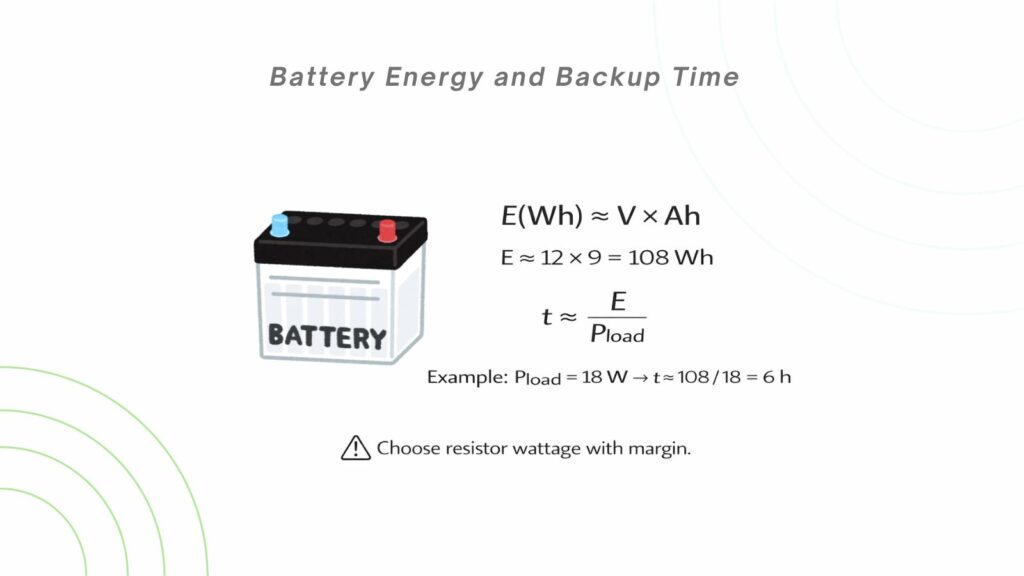
Battery Energy and Backup Time (The Engineering Shortcut)
Battery questions are extremely common because they connect directly to solar systems, UPS design, and portable electronics. In practice, the runtime will be lower due to losses, inverter efficiency, battery aging, and discharge limits. Still, this estimate is one of the most valuable electrical energy and power calculations for real projects.
Efficiency: Making Your Estimates Realistic
No converter or power supply is perfect. If you ignore efficiency, your input power or battery requirement will be underestimated. This is the kind of realism that makes electrical energy and power calculations stand out as “engineering-grade” content rather than generic textbook copying.
Peak Power vs Energy: Why Short Use Can Still Cost?
Readers often believe a high-power appliance always costs more. The truth is: cost depends on energy, not power alone.
A 1500 W kettle used for 10 minutes:
- Convert time:
10 mins = 10 / 60 = 0.167 h
- Power in kW:
1500W = 1.5kW
Energy:
E = 1.5 x 0.167 = 0.25 kWh
A 100 W bulb would need 2.5 hours to use the same energy:
E = 0.1 x 2.5 = 0.25 kWh
This comparison keeps users attached because it changes how they think about consumption. And it’s exactly what good electrical energy and power calculations content should do.
A Simple Workflow Engineers Use (So You Don’t Get Lost)
Many students fail questions not because the topic is difficult, but because they jump between formulas without a plan. Here’s a reliable workflow that works for most problems:
First, identify what the question asks: power (W) or energy (Wh/kWh). Then write the known values with units. Next, calculate power using P = VI or resistance-based formulas. Finally, calculate energy using E = pt if time is involved.
This workflow keeps electrical energy and power calculations consistent and reduces careless mistakes.
Common Mistakes That Destroy Correct Answers
Most wrong answers come from predictable errors:
A very common mistake is mixing power and energy units is writing “kW” when the question needs “kWh.” Another is forgetting to convert minutes to hours when calculating energy. People also sometimes treat kWh as a “rate,” which it is not; it’s a total.
If you want a quick self-check, look at your final unit. If the question is about electricity bill usage, your final answer should be in kWh. If it is about device capacity or rating, your final answer often should be in watts. These checks make electrical energy and power calculations far more reliable.
What You Should Be Able to Do After This?
After reading this guide, you should be able to calculate power from voltage and current, energy from power and time, and kWh for appliances and billing. You should also be able to estimate daily and monthly usage, check resistor power dissipation, estimate battery backup time, and apply efficiency for more realistic planning. Those skills cover the majority of practical electrical energy and power calculations used in beginner engineering, home energy estimates, and everyday technical work.