
If you work around modern electrical systems long enough, you start hearing the same complaints. Transformers run hotter than expected. Breakers trip for no obvious reason. Neutrals carry more current than anyone thought they would. Sensitive equipment behaves strangely even when the voltage looks “close enough.” In many of those cases, harmonics are part of the story. They are not the only power quality problem engineers face, but they are one of the most common in buildings and industrial plants filled with electronic loads. Eaton, ABB, and Schneider Electric all describe harmonics as a major power-quality issue created by today’s nonlinear equipment, especially as facilities fill up with drives, servers, UPS systems, lighting electronics, and charger-based loads.
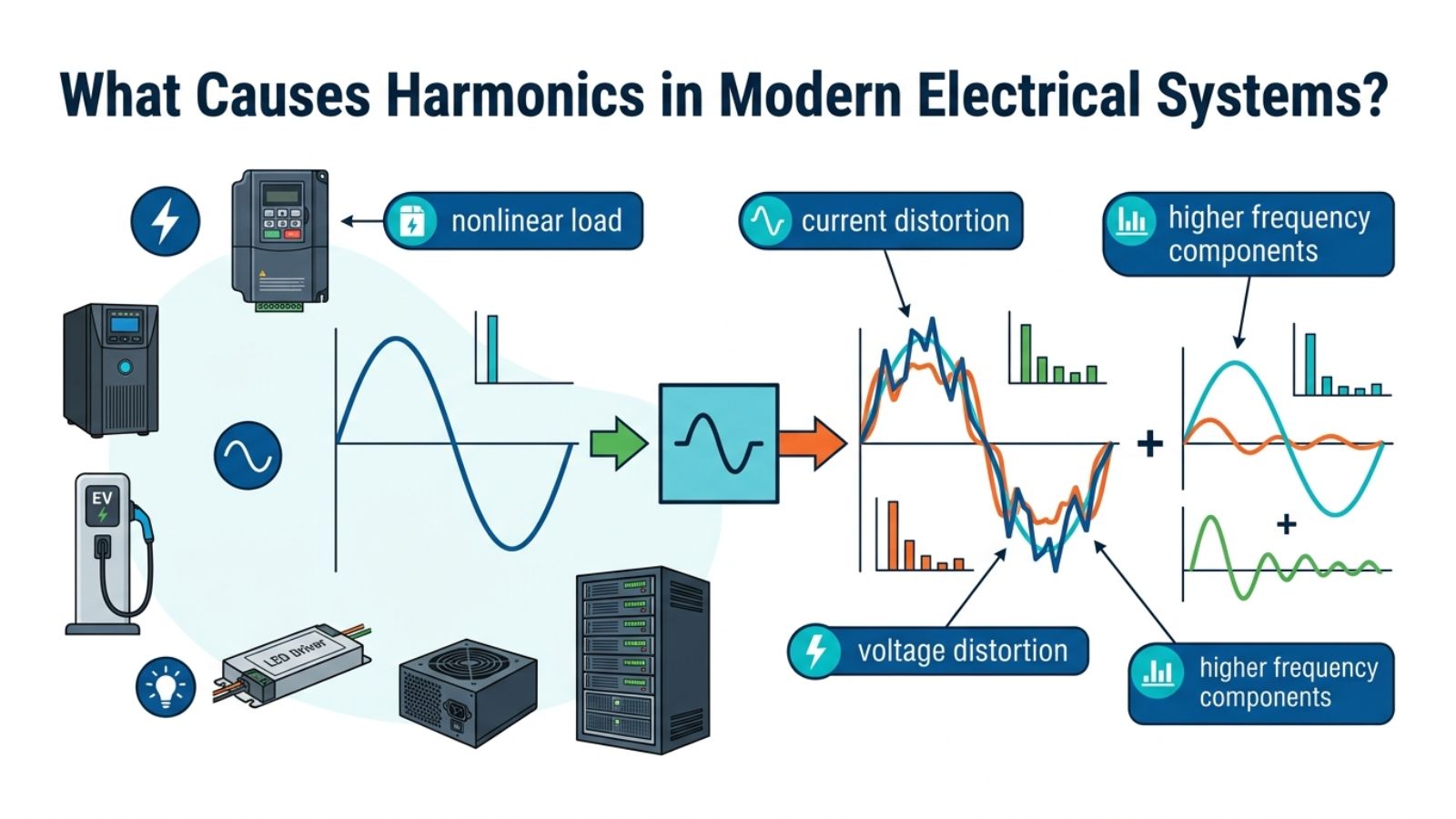
The basic idea is simple. An ideal AC system carries a smooth sinusoidal waveform at the fundamental frequency, usually 50 Hz or 60 Hz. Harmonics appear when the current or voltage is distorted by additional frequency components above the fundamental. Eaton explains that these supplemental frequencies distort the waveform, while ABB describes harmonic currents as being created by nonlinear loads connected to the distribution system.
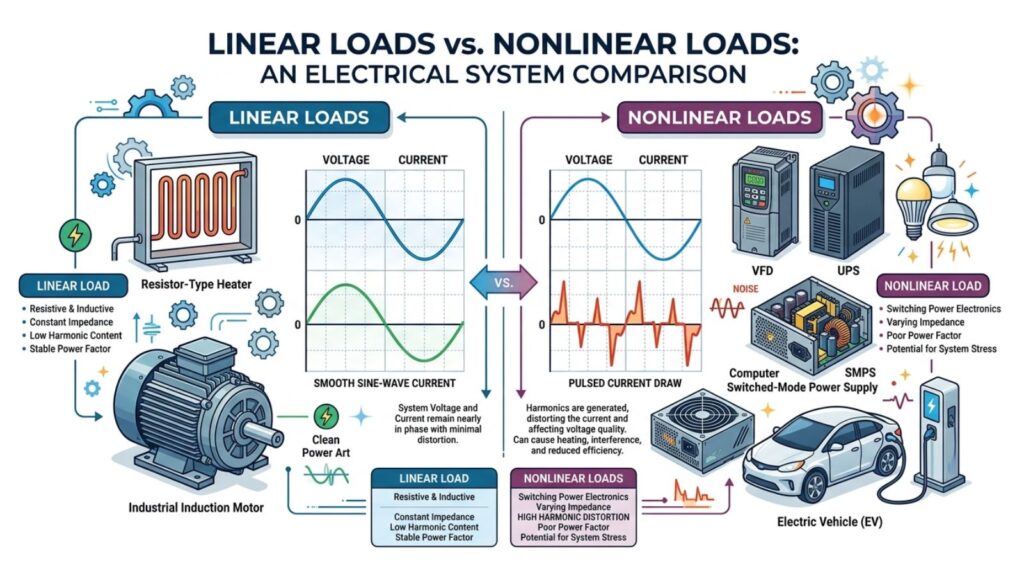
In practical field work, the most important answer to the question “what causes harmonics?” is this: nonlinear loads. A nonlinear load does not draw current in the same smooth shape as the applied voltage. Instead, it pulls current in chopped, pulsed, or discontinuous chunks. That distorted current then flows through the impedance of the electrical system and creates voltage distortion as well. Eaton states this clearly: Nonlinear loads are the most common source of current distortion, while voltage distortion is commonly produced when distorted current flows through system impedance.
Why are harmonics more common in modern systems?
Older electrical systems had plenty of loads, but many of them were relatively linear. Resistance heaters, incandescent lamps, and simple induction motors were usually not the main harmonic troublemakers. Modern buildings are different. Today’s systems rely heavily on power electronics, and power electronics are exactly where harmonics begin to show up. Schneider Electric notes that harmonics are generated wherever modern devices convert AC from the grid into DC, and much of the equipment associated with electrification and digital infrastructure depends on that type of conversion. Eaton similarly says harmonics result from nonlinear loads that convert AC line voltage to DC through electronic switching devices.
That is why harmonics have become much more visible in recent years. We now install variable frequency drives to improve motor efficiency, UPS systems to support digital continuity, LED lighting to reduce energy use, EV chargers to support electrified transport, and server-heavy spaces to support data and automation. These are all useful technologies. They are also exactly the kinds of loads that inject harmonic currents into a distribution system. Eaton specifically lists VFDs, EC motors, rectifiers, computers, LED lights, and EV chargers among the most prevalent and growing harmonic sources today.
This is the point many beginners miss. Harmonics are not a sign that modern equipment is “bad.” They are often a side effect of equipment that is efficient, controllable, and electronically sophisticated. The real engineering challenge is not avoiding all nonlinear loads, because that is no longer realistic. The challenge is understanding how those loads interact with the rest of the power system. ABB notes that nonlinear devices now make up an ever-increasing share of industrial and commercial load, which is why harmonic studies have become a more important part of system design and operation.
The loads that most often cause harmonics
In the field, some harmonic sources appear over and over again. Variable frequency drives are among the most common. Drives use rectification and switching to control motor speed, and in doing so, they can produce characteristic harmonic orders such as the 5th, 7th, 11th, and 13th in common six-pulse configurations. Eaton’s harmonic source guidance and ABB’s technical guide both identify VFDs and drive-based systems as major harmonic sources in commercial and industrial installations.
UPS systems and server infrastructure are another major source. In data centers and technology-heavy buildings, the input stages of UPS equipment, switched-mode supplies, and server power electronics can distort the current waveform significantly. Eaton’s data-center guidance specifically points to servers, VFDs, fluorescent lighting, and other electronic devices as sources of harmonic distortion, while its industrial harmonic study paper lists UPS systems, chargers, switched-mode supplies, and static converters among the main harmonic-producing devices.
Lighting has changed too. Engineers sometimes assume lighting is a minor load, but electronically ballasted fluorescent systems and LED drivers can be meaningful harmonic contributors, especially in commercial buildings with large lighting densities. Eaton’s source guide explicitly includes LED and fluorescent lighting among major harmonic-producing loads, and ABB includes electronic lighting among the common nonlinear loads that distort the system.
Battery chargers and EV chargers also belong on the list. As buildings electrify, charger-based loads become more common, and these loads use power electronic conversion stages that can contribute to harmonic distortion. Eaton names battery chargers and EV chargers as growing harmonic sources, while Schneider Electric notes that power quality, including harmonic distortion, is increasingly important as EV charging grows.
Then there are arcing and magnetic sources. Welders, arc furnaces, and certain saturating magnetic devices can also produce harmonics. Eaton’s industrial harmonic study paper identifies arc furnaces and saturated magnetic devices as additional sources beyond the usual converter-based loads.
The real mechanism: current distortion first, voltage distortion second
One of the most useful ways to understand harmonics is to separate current harmonics from voltage harmonics. A lot of loads inject distorted current, but the voltage distortion you actually see at a bus depends on the impedance of the system. In other words, the load does not distort the voltage all by itself. It distorts the current, and that harmonic current flowing through conductors, transformers, and source impedance produces harmonic voltage drop. Eaton explains this directly, and ABB’s application guidance also notes that harmonics appear on the voltage waveform because electronic devices draw current in a nonlinear way.
This matters because two facilities can have similar nonlinear loads and still experience very different harmonic behavior. A “stiff” system with lower impedance may tolerate certain harmonic currents better than a weaker system with higher impedance. That is why an engineer should never look only at the load list. The supply transformer size, conductor lengths, upstream impedance, and the location of the load all influence how badly harmonics show up at the point of use. Eaton’s industrial harmonic-study guidance emphasizes modeling system impedance as a function of frequency, because the effect of harmonic sources depends heavily on the electrical system they are connected to.
Why do single-phase electronics often create neutral problems?
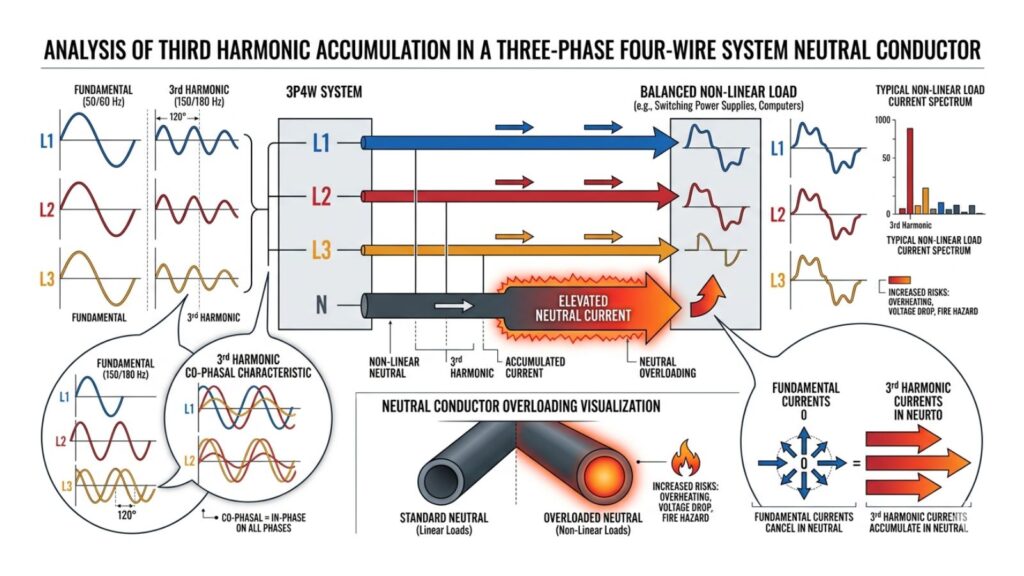
One of the most misunderstood harmonic issues in modern buildings is neutral conductor loading. In an ideal balanced three-phase system, the neutral current is small because the phase currents cancel. That comforting picture starts to break down when you add large numbers of single-phase nonlinear loads such as computers, office electronics, small power supplies, and electronic lighting.
These loads often generate strong triplen harmonics, meaning the 3rd, 9th, 15th, and other multiples of three. Those triple components do not cancel in the neutral way the fundamental does. Instead, they add together. Eaton notes that single-phase nonlinear loads generate significant triplen harmonic currents and that triplen harmonics may drive neutral current as high as 1.7 times the phase current. ABB likewise notes that third harmonic components can accumulate in the neutral conductor and, in some cases, exceed the phase current.
This is why harmonic problems often show up first in commercial offices, control rooms, IT spaces, and lighting-heavy buildings rather than in places where people expect them. The phase currents may look reasonable, but the neutral runs hot. Someone checks the conductors and wonders how the neutral got into trouble before the phases did. From an engineering standpoint, that is a classic harmonic clue.
Why do capacitors sometimes make a harmonic problem worse?
Another cause of trouble is not the creation of harmonics themselves, but the amplification of harmonics that already exist. This is where power factor correction capacitors enter the story.
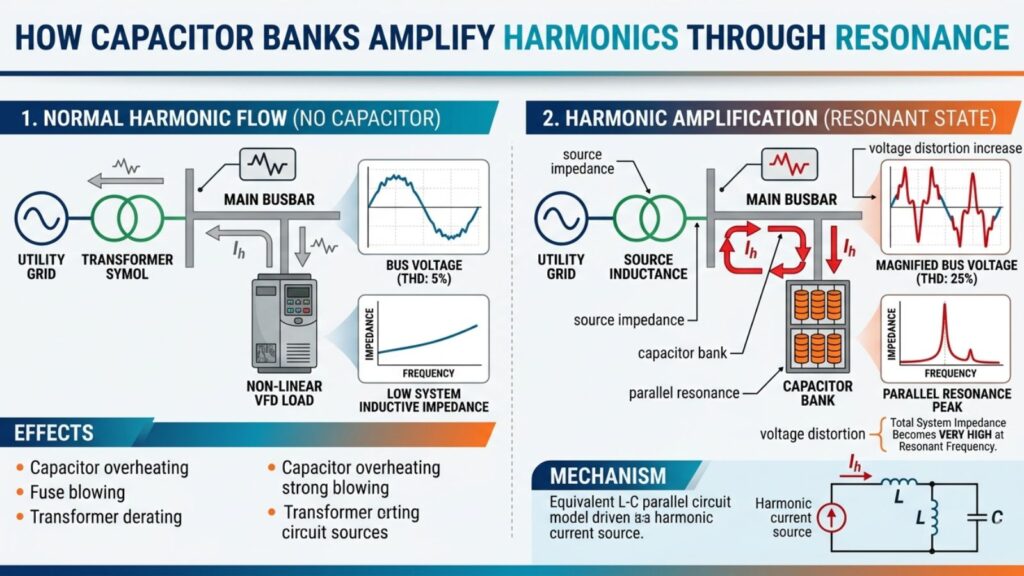
Capacitors do not normally create harmonics on their own. The problem is that they can interact with system inductance and create a resonant condition near one of the harmonic frequencies already present in the system. Eaton warns that capacitor banks in systems with six-pulse drives can amplify harmonics if a parallel resonance condition exists, resulting in excessive capacitor currents, blown fuses, and severe voltage distortion. Eaton also states in a separate white paper that every system with a capacitor has a parallel resonant point, and if that resonant point lines up with an existing harmonic frequency, the result can be damaging harmonic resonance.
This is why careless power factor correction can create expensive surprises. A plant adds capacitors to improve power factor, the utility bill looks better for a while, and then strange overheating or capacitor failures begin. The capacitors were not the original harmonic source, but they changed the system response enough to make the existing distortion much more severe. That is not a theory problem. It is a very real field problem.
Common symptoms engineers see when harmonics are present
Harmonics do not always announce themselves clearly. In real installations, they often look like secondary problems. ABB lists typical effects such as overheating of transformers, cables, motors, generators, and capacitors, along with flickering displays and lighting, breaker tripping, computer failures, and false meter readings. Eaton’s data-center guidance adds reduced efficiency, increased heating losses, reduced reliability, and inaccurate metering among the practical consequences. Schneider Electric also points to nuisance tripping, overheating, erratic operation, and even fire risk in serious cases.
That explains why harmonic problems are easy to misdiagnose. A technician may replace a breaker, tighten a termination, or blame an overloaded transformer without first asking whether waveform distortion is driving the stress. Harmonics are especially good at hiding behind symptoms that look purely thermal or operational. If the root cause is not identified, the system may continue failing in different ways even after individual components are replaced. ABB explicitly notes that if these symptoms appear and the cause is not known, harmonic distortion is worth investigating.
Why harmonics are a bigger concern now than they were before
Modern systems are more power-electronic, more distributed, and often more tightly loaded than older installations. That combination makes harmonic behavior more relevant. EV charging, data centers, electronically commutated HVAC equipment, LED lighting, and UPS-backed digital infrastructure all push facilities toward a harmonic-rich environment. Schneider Electric highlights the role of AC-to-DC conversion in modern green and digital technologies, while Eaton points to VFDs, EC motors, battery chargers, EV chargers, computers, and lighting as today’s fastest-growing source categories.
At the same time, expectations for reliability are higher. A factory, lab, hospital, telecom room, or server space is less tolerant of nuisance trips and overheating than older, simpler facilities used to be. That is one reason standards and studies matter more now. ABB notes that standards such as IEEE 519 and IEC 61000 are used to define acceptable harmonic distortion levels, and that harmonic analysis helps engineers and operators stay within those expectations.
What does a good engineer check first?
When I look at a suspected harmonic problem, I do not start by blaming the nearest VFD and walking away. I start by asking four questions. What nonlinear loads are present? Where are they connected? How stiff is the system at that point? Have capacitors, filters, or other system changes altered the resonance picture?
That approach matches the logic laid out in ABB’s harmonic-analysis guidance, which recommends identifying all nonlinear loads, measuring harmonic levels, examining harmonic spectra, calculating THD, and modeling the system where necessary. Eaton’s industrial harmonic-study guidance makes the same point from another angle: harmonic problems have to be evaluated in the context of both source behavior and system impedance.
In many cases, measuring is what separates guesswork from engineering. THD values, harmonic spectra, neutral current behavior, and conditions across different operating periods tell you far more than casual observation ever will. Without measurement, people often spend money treating the wrong problem.
The practical answer
So, what causes harmonics in modern electrical systems?
The primary cause is the widespread use of nonlinear loads, particularly those based on power-electronic conversion. VFDs, UPS systems, switched-mode power supplies, LED drivers, computers, EV chargers, battery chargers, welders, and some magnetic devices all distort current instead of drawing it as a clean sine wave. That harmonic current then interacts with the system impedance, producing voltage distortion. In three-phase systems with many single-phase electronic loads, triplen harmonics can accumulate in the neutral. In systems with capacitor banks, existing harmonics can be amplified by resonance.
The deeper lesson is that harmonics are not caused by “too much electricity” or by one bad component. They are caused by the way modern equipment draws and processes power. That is why the best engineers do not ask only, “What device is installed?” They also ask, “How does this device draw current, and how will that current interact with the rest of the system?” That is the question that usually leads to the right diagnosis.