
The short answer is no, not always.
That is the honest answer I would give as an engineer before I gave anyone a sales pitch. A lot of homeowners hear the same line the moment they mention a heat pump or EV charger: “You need to upgrade to 200 amps.” Sometimes that is correct. Many times it is not. The real answer depends on the electrical service you already have, the condition of the panel, the size of the new load, how the house is currently wired, and whether the new equipment will run at the same time as other large loads.
This is where practical engineering matters. You do not make a sound decision by looking only at the panel door and the main breaker rating. You make it by understanding how the house actually uses power, what the new equipment really draws, and whether the existing service can carry that demand safely and legally. ENERGY STAR notes that electric-ready homes are being prepared for loads like heat pumps and EV chargers, but the extent of upgrades depends on the home. It also notes that many newer homes already have 200A service, and that if a home already has central AC, switching to a heat pump often does not require an electrical upgrade.
I have seen homeowners spend thousands on a service upgrade when a lower-cost, better-targeted solution would have done the job. I have also seen the opposite case, where someone tried to avoid an upgrade even though the existing panel was overcrowded, outdated, or clearly undersized for the loads being added. The goal is not to force every house into a 200A template. The goal is to make a sound decision based on real electrical constraints.
Why does this question matter more now?
This topic is getting more attention because homes are changing. Space heating is shifting toward heat pumps. Transportation is shifting toward electric vehicles. In many houses, those two changes bring the largest new electrical loads the home has ever seen. The Department of Energy says some homes may need wiring or panel upgrades to add new electric equipment such as heat pumps, and it separately highlights home EV charging as part of the electrification path.
That does not mean every home needs major electrical work. It means the old assumptions are no longer good enough. A home that was fine for gas heat, gas water heating, and no EV may need a closer look once the owner adds a heat pump and starts charging a vehicle every night. This is also why so many people get confused. A house can feel electrically “normal” in everyday life, but still be close to its practical limit when one or two new heavy loads are added. The trick is separating fear from facts.
Start with the most important question: what do you actually have now?
Before anyone talks about upgrading the panel, you need a clear picture of the existing installation.
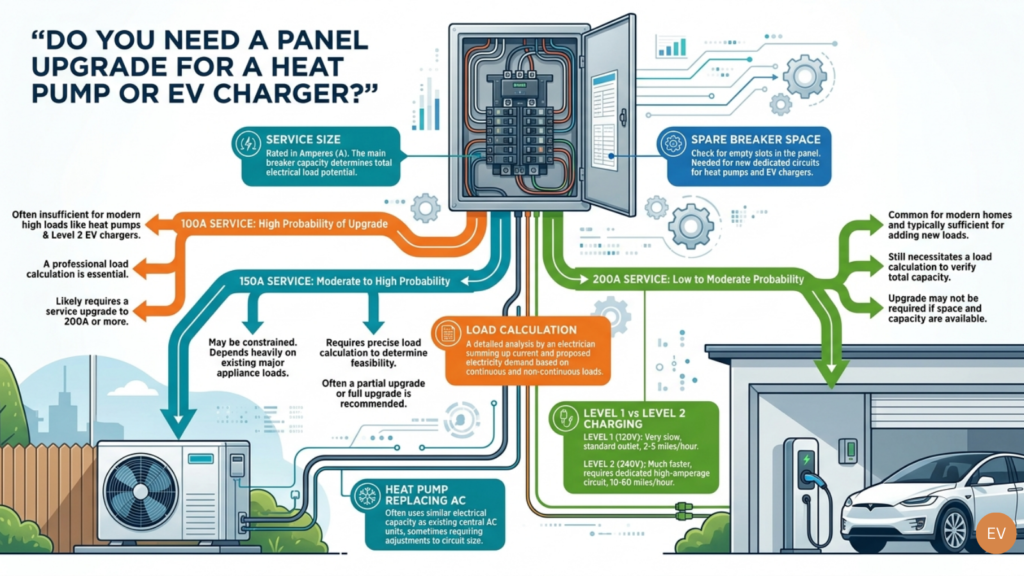
First, check the service size. That is usually indicated by the main breaker rating, often 100A, 125A, 150A, or 200A. Second, look at the panel condition. Is it modern, properly labeled, and in good physical shape? Third, check whether there is actual room for new breakers. A house may have enough total ampacity on paper, but still lack two adjacent spaces for a 240V branch circuit. Fourth, look at the existing major loads. Electric range, electric dryer, water heater, hot tub, pool pump, electric furnace, backup strip heat, and workshop equipment all matter.
This is where engineering judgment starts. A clean 100A panel in a modest home with gas cooking and gas water heating is very different from a 100A panel in a larger home with multiple electric appliances already installed. A 200A panel with no spare spaces can still need subpanel work. A 150A service in good condition may still be perfectly adequate if the new loads are chosen carefully.
The label on the main breaker tells only part of the story. The load profile tells the rest.
Heat pump first: Does it really add a big new load?
A heat pump does not always mean a major electrical jump. In many homes, especially those that already have central air conditioning, the outdoor condenser circuit already exists. In those cases, switching from AC plus a fossil-fuel furnace to a heat pump can be more of an equipment swap than a whole-house electrical shock. ENERGY STAR explicitly notes that if a home already has central AC, an electrical upgrade is generally not needed just to switch to a heat pump.
That is one of the biggest misconceptions I see. People hear “electric heat” and immediately imagine a giant resistance heater. But a heat pump is not the same thing as electric resistance heat. The DOE says modern heat pumps can reduce electricity use for heating by about 65% compared with electric resistance systems such as baseboard heaters or electric furnaces.
Still, you should not oversimplify it. The electrical impact of a heat pump depends on the actual system design. A ducted split system, a cold-climate unit, a multi-zone mini-split system, or a dual-fuel arrangement can all have different electrical requirements. Backup heat matters too. If the system includes electric auxiliary heat strips, the peak demand picture changes a lot. In the field, many “surprise” panel issues come not from the compressor, but from resistance backup heat.
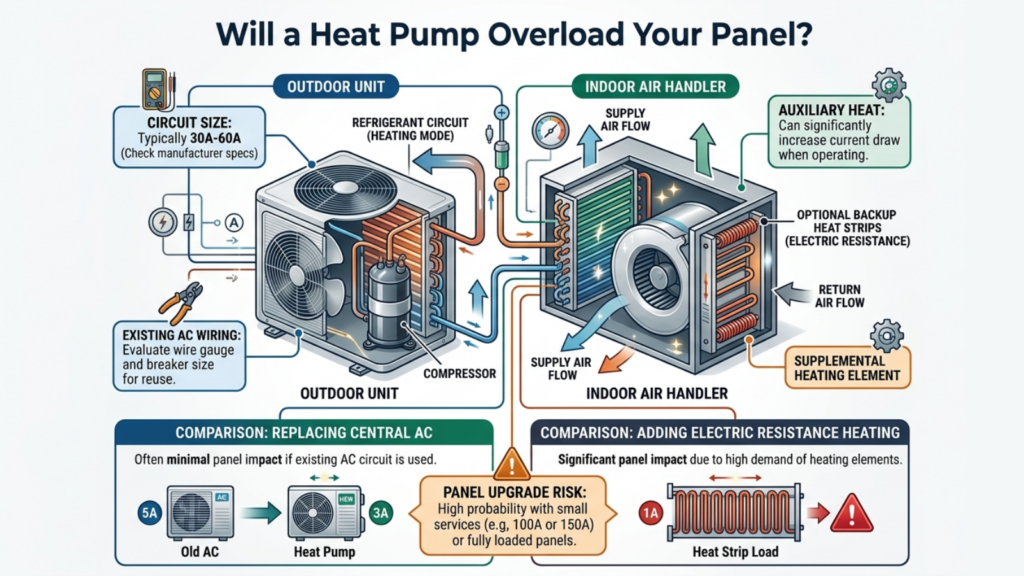
So the right question is not “Does a heat pump require a panel upgrade?” The right question is, “What are the minimum circuit ampacity and overcurrent protection requirements of the exact heat pump system being installed, including any auxiliary heat?”
That answer lives on the equipment data, not in guesswork.
EV charger next: This is often the load that changes the conversation
EV charging is where many homes hit a real electrical decision point.
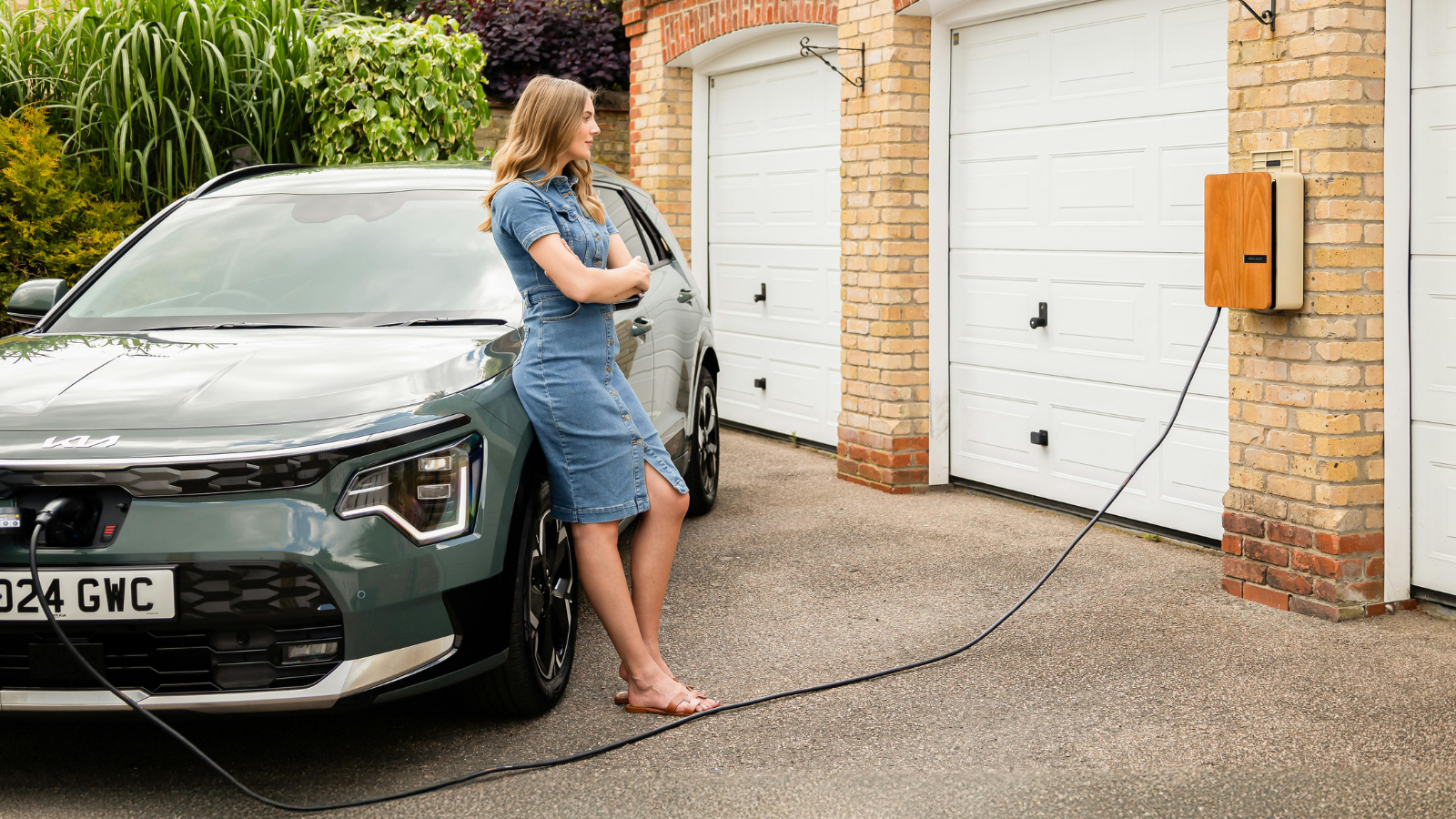
Most EV owners charge overnight at home using Level 1 or Level 2 equipment. Level 1 uses standard 120V power and, for many drivers, can cover daily needs overnight if a dedicated branch circuit is available. Level 2 uses 240V equipment and is chosen when faster charging is needed. The same source notes that some homes do not have enough electric capacity for Level 2 charging without additional work, and that a qualified electrician should assess available capacity.
This is exactly right from a practical standpoint. Many homeowners do not actually need a high-powered Level 2 charger. If the daily driving distance is modest, Level 1 may be enough. ENERGY STAR also notes that the charger cord that comes with a new EV can use a standard 120V socket and may provide up to about 60 miles of charge overnight.
That point matters because many expensive upgrades begin with a bad assumption. The homeowner assumes they need the fastest possible charger. The contractor designs around that maximum case. Suddenly, a perfectly usable house is being pushed into a full-service upgrade, when a lower charging rate would have met the real transportation need.
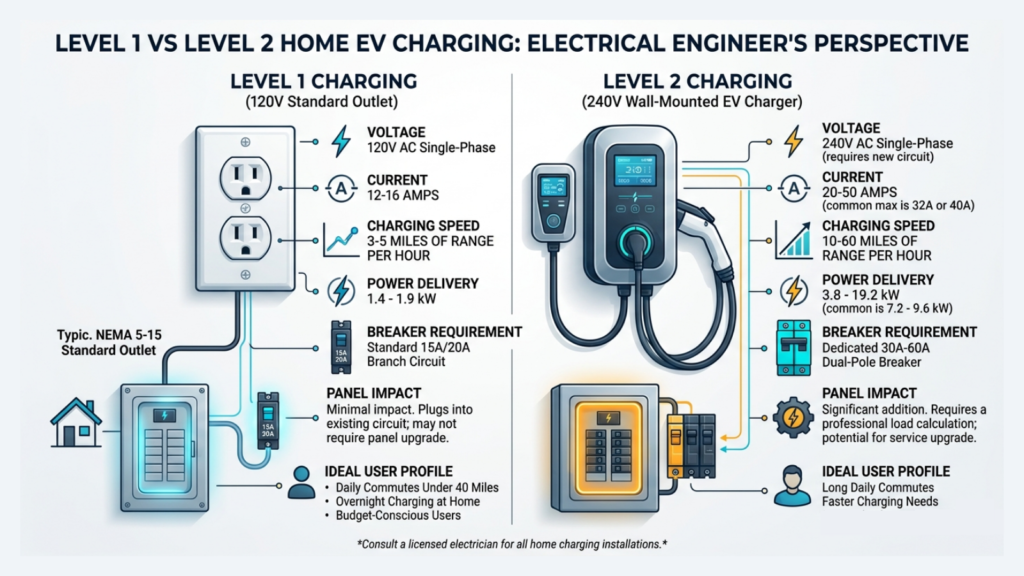
Of course, Level 2 makes sense in many cases. Long commutes, large-battery EVs, multiple drivers, and irregular schedules can all justify it. But the required charging speed should be selected from the owner’s actual use case, not from the marketing brochure.
Why do electricians and engineers pay attention to EV charging differently?
One reason EV chargers get special attention is that EV charging is treated as a continuous load. The NEC reflected in NFPA material states that EV charging loads are considered continuous loads, and that service and feeder sizing must follow the product ratings unless controls are used to limit the installation rating. More generally, NFPA material also states that branch-circuit overcurrent protection for continuous loads is not less than the noncontinuous load plus 125% of the continuous load.
That is why a charger that sounds modest on paper can still have a noticeable design impact. The branch circuit, feeder, and service implications are not judged only by casual nameplate thinking. They are judged by code-based loading rules. The engineering lesson is simple. Do not ask only, “How many amps is the charger?” Ask, “How will this charger be treated in the service and branch circuit calculation?”
That small change in thinking prevents a lot of expensive mistakes.
So, when do you probably need a panel upgrade?
In my view, the clearest cases are these.
You probably need a real upgrade if the existing panel is obsolete, damaged, overheating, overcrowded, or otherwise unsafe. No amount of clever load juggling should be used to rescue bad hardware.
You probably need an upgrade if the formal load calculation shows the service is undersized once the new equipment is included.
You probably need an upgrade if there is not enough physical breaker space and the panel is already at its practical limit.
You probably need an upgrade if the heat pump includes substantial electric backup heat, the home already has several large electric loads, and you are adding a high-amperage Level 2 EV charger on top of that.
You probably also need one if the utility service itself is too small for the planned electrification path, not just today’s project. This matters when the owner is adding a heat pump now, an EV charger soon, and maybe an induction range or heat pump water heater next year.
That last point is important. Sometimes the numbers say you can squeeze one project into the existing setup, but not in a way that makes sense for the next five years. Good engineering looks ahead.
And when might you not need one?
This is the part many homeowners are happy to hear.
You may not need a panel upgrade if the home already has 200A service and the panel is in good condition.
You may not need one if the heat pump is replacing central AC and the existing circuit can support the selected unit.
You may not need one if the EV will be charged on Level 1 and the owner’s daily mileage is moderate.
You may not need one if the Level 2 charger is set to a lower output current that still meets the household’s real charging needs.
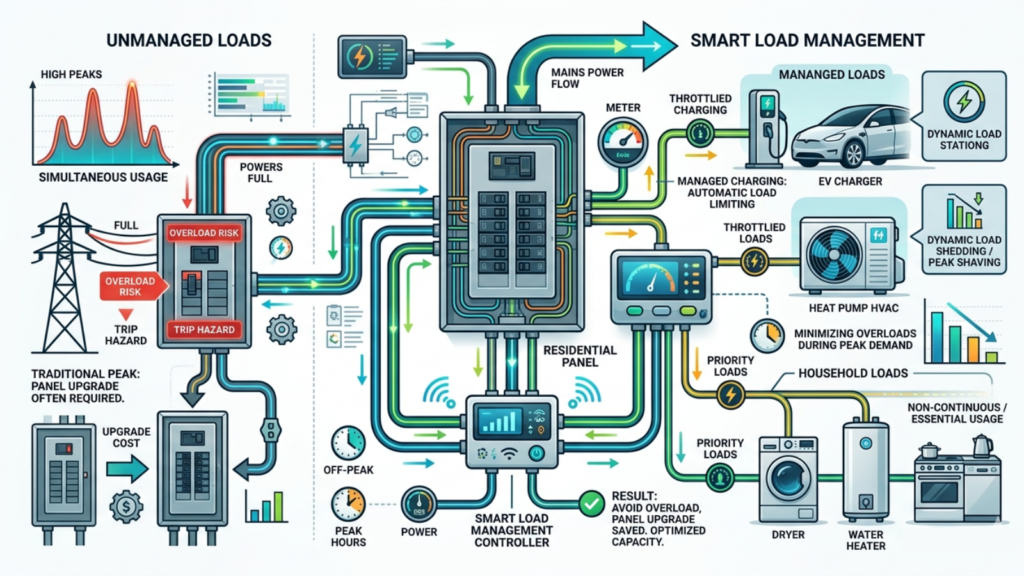
You may not need one if a managed charging or load control approach is allowed and properly applied. DOE materials on managed charging note that it can reduce upgrade costs and keep charging within existing electrical capacity. NFPA language also recognizes that EV installations can be limited through controls.
This is one of the most useful modern tools in residential electrification. Instead of assuming all loads will run at full value at the same moment, a control system can limit EV charging when the rest of the house is drawing heavily. That is not a shortcut or a hack when it is designed correctly. It is an engineering solution.
The smartest way to evaluate the house
When I assess this kind of problem, I do not start with “100A bad, 200A good.” I start with a sequence.
First, identify the exact service size, panel model, and available breaker spaces.
Second, list the major existing loads and note which are electric and which are gas.
Third, get the actual electrical data for the proposed heat pump and EV charger. Not generic internet values. Real equipment values.
Fourth, look at how the home is used. Is this a single EV or two? How many miles per day? Is the heat pump the only major electrification project, or just the first one?
Fifth, perform the required code-based calculation through a qualified professional and compare that with practical operating patterns.
Sixth, consider alternatives before jumping to a full upgrade. Lower charger output, managed charging, subpanel work, sequencing loads, or choosing a different equipment combination can all change the answer.
This sequence is boring compared with a dramatic sales pitch. It is also the sequence that saves money and avoids regrets.
A simple real-world example
Imagine a house with 100A service, a gas range, a gas water heater, a gas dryer, and existing central AC. The owner wants to replace the furnace and AC with a heat pump and add one EV.
In many cases, that is not automatically a 200A job. The heat pump may replace the existing AC circuit arrangement with only moderate electrical change, and the EV may be perfectly manageable with Level 1 charging or a lower-output Level 2 charger with load management. The formal calculation may still require an upgrade, but it is far from a foregone conclusion.
Now imagine a different house. It also has 100A service, but it already has an electric range, electric dryer, electric water heater, and an older panel with limited space. The owner wants a cold-climate heat pump with electric auxiliary heat plus a 48A Level 2 charger.
That is a very different picture. In that case, a panel or service upgrade becomes much more likely, not because heat pumps or EVs are inherently impossible on 100A service, but because the combined load picture is much heavier.
That is why blanket advice is weak advice.
Cost, incentives, and planning
In the United States, there may be tax credits or rebates that help reduce the cost of panel and electrification work. DOE and ENERGY STAR both note that panel upgrades may qualify under certain conditions, and ENERGY STAR states that the federal panel credit applies to qualifying panelboard, sub-panelboard, branch-circuit, or feeder improvements installed with qualifying efficient equipment, with the panel having a load capacity of at least 200 amps. DOE also notes a federal EV charger tax credit for eligible installations.
The practical lesson is this: if you are going to do the work, coordinate the projects. Panel work done as part of a planned electrification package is usually easier to justify than panel work done reactively, one load at a time.
Even if the house does not need an upgrade today, it may still make sense to think ahead. An empty conduit, better panel organization, reserved space, or a future-ready subpanel can make the next project much easier.
My engineer’s verdict
If someone asked me this question on site, I would answer like this:
Do not assume you need a panel upgrade just because you are installing a heat pump or an EV charger. Also, do not assume you can avoid one just because the lights still turn on today. The right answer comes from the existing service size, panel condition, actual equipment ratings, formal load calculation, and whether smart controls or lower charging rates can solve the problem cleanly.
A heat pump alone is often less dramatic than people expect, especially in homes that already have central AC. An EV charger is often the load that pushes the house into a more serious electrical review. But even then, the solution is not always “replace everything.” Sometimes it is. Sometimes it is not.
The best decision is the one made from measured facts, not assumptions.