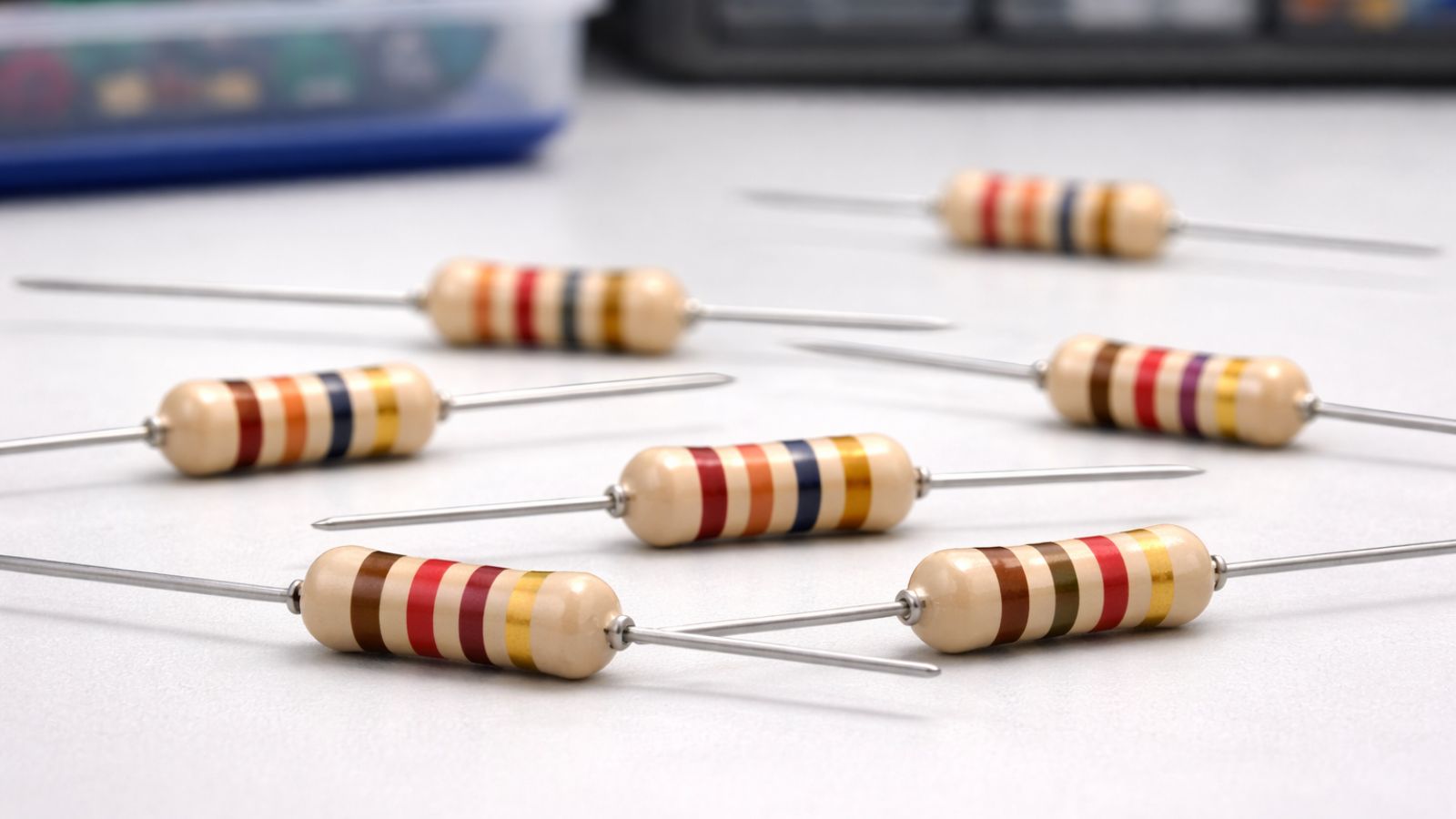

If you have ever pulled a resistor from a mixed box and wondered, “Is this 1 kΩ or 10 kΩ?”, you are not alone. In practical engineering work, resistors are everywhere. They set LED current, define amplifier gain, create voltage dividers, and shape timing circuits. The problem is simple. Many through-hole resistors do not print their value as text. Instead, they use colored bands.
After more than a decade working with industrial panels, instrumentation boards, and student prototypes, I can tell you this. Reading resistor bands is a core skill. It saves time, prevents incorrect assembly, and reduces debugging headaches. Still, it is easy to misread colors under poor lighting or when the resistor is dusty or heat-aged.
That is why this guide does two things. First, it teaches you how to read the color code properly for 4-band, 5-band, and 6-band resistors with clear examples. Second, it shows you when and how to use a resistor color code calculator (also called a resistor color code tool) to get instant, accurate results.
By the end, you will be able to decode resistors confidently, cross-check with a meter, and avoid the most common errors that even professionals make when they are in a hurry.
Why do resistors use color codes?
Resistors are small components. Printing “4.7 kΩ ±5%” on a tiny cylindrical body is not practical. Color bands are compact and readable without magnification. They also survive heat and handling better than printed text.
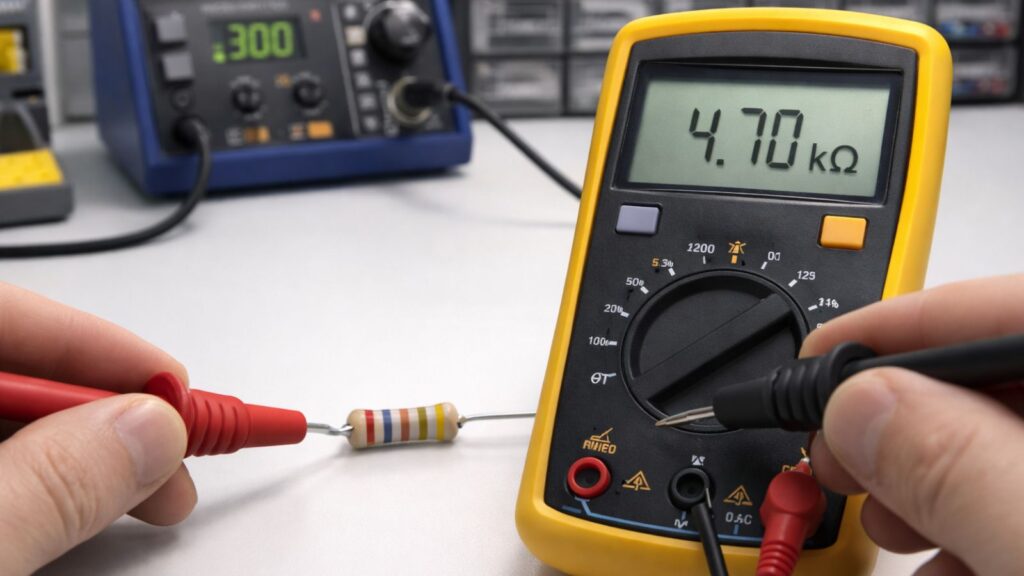
Color coding also supports fast production and inspection. In manufacturing and maintenance, technicians can quickly confirm a value by sight, especially for common values. The limitation is that human vision is not a measuring instrument. Different lighting, faded paint, or similar colors can cause mistakes. That is why engineers often combine three checks. You read the color bands. You verify the circuit reference designator and BOM. Then you confirm with a multimeter when the value is critical.
Resistor color code basics: digits, multiplier, tolerance
A resistor color code is built from a few pieces of information.
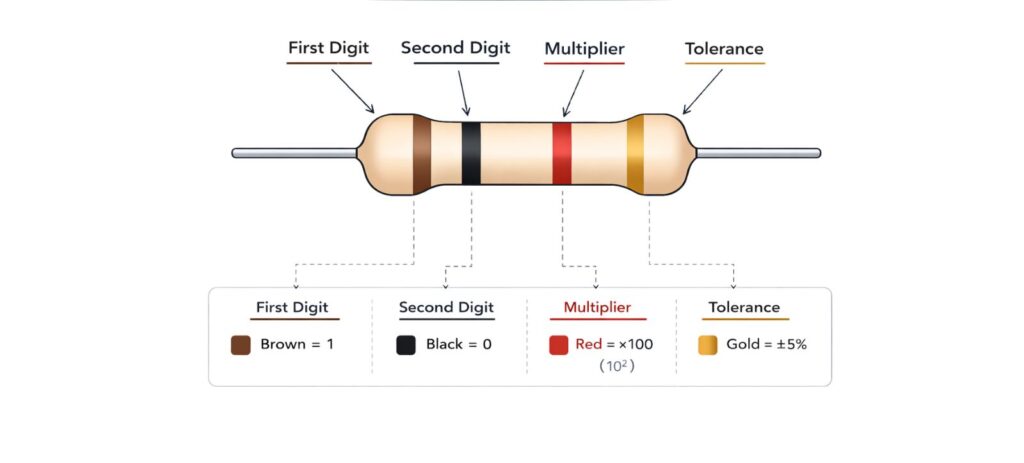
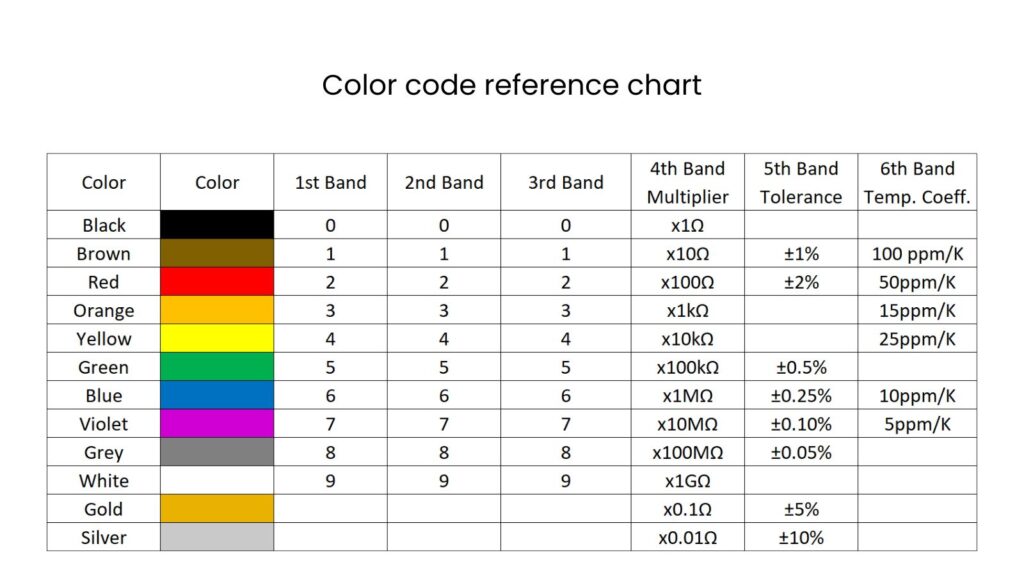
The first bands represent significant digits. Then a multiplier scales the number. After that, a tolerance band indicates how much the real resistance can vary from the nominal value. Some precision resistors add a temperature coefficient band, which matters in sensitive analog work. Most of the time, you will see 4-band resistors in general electronics and student projects. You will also see 5-band resistors in precision circuits, instrumentation, and quality power supplies. 6-band resistors appear when temperature drift is specified.
The digit colors (0 to 9)
These colors map to digits:
- Black = 0
- Brown = 1
- Red = 2
- Orange = 3
- Yellow = 4
- Green = 5
- Blue = 6
- Violet = 7
- Gray = 8
- White = 9
This mapping is the foundation. Once you memorize it, everything else becomes easier.
The multiplier idea
The multiplier band tells you what power of ten to multiply by.
For example, if the first two digits give 47 and the multiplier is red, you multiply by 10². That gives 4700 Ω, which is 4.7 kΩ. Some multipliers are also fractional. Gold means multiply by 0.1. Silver means multiply by 0.01. These are used for low-value resistors like 0.47 Ω or 0.22 Ω.
Tolerance basics
Tolerance is how far the actual resistance can deviate from the labeled value. A common carbon film resistor has ±5% tolerance (gold band). That means a 1 kΩ resistor can be anywhere from 950 Ω to 1050 Ω and still be within spec.
Precision resistors often use ±1% (brown) or ±0.1% (violet). These matter in measurement circuits, filters, and accurate references.
How to identify the first band?
This is where many mistakes start.
Most resistors have one band that is spaced a little farther from the others. That separated band is usually the tolerance band, and it goes on the right side when you read the resistor. If you are unsure, look for gold or silver. Those are commonly used for tolerance, and they are rarely used as the first digit in typical resistors. Also, on many resistors, the first band is closer to one lead. So you read from the side where the bands start nearer the end.
If you still cannot tell, do not guess. Use a resistor color code calculator or measure the resistor with a multimeter and confirm.
4-band resistor color code
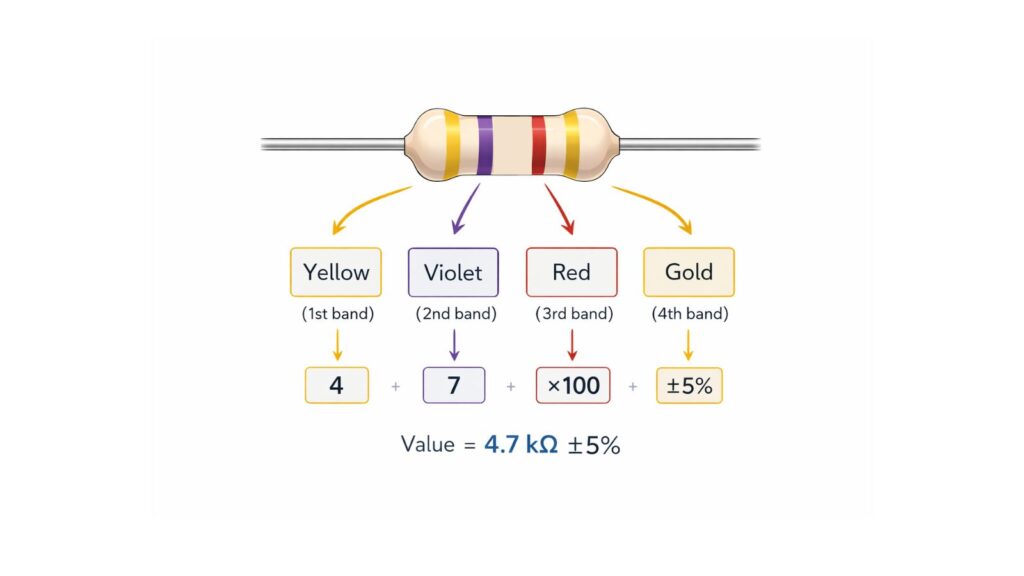
A 4-band resistor is read like this:
Band 1 = first digit
Band 2 = second digit
Band 3 = multiplier
Band 4 = tolerance
This is the most common system for general-purpose resistors.
Example 1: Yellow Violet Red Gold
Yellow = 4
Violet = 7
Red multiplier = 10²
Gold tolerance = ±5%
So the value is 47 × 10² = 4700 Ω = 4.7 kΩ ±5%
Example 2: Brown Black Orange Gold
Brown = 1
Black = 0
Orange multiplier = 10³
Gold tolerance = ±5%
So the value is 10 × 10³ = 10000 Ω = 10 kΩ ±5%
Example 3: Green Blue Gold Gold
Green = 5
Blue = 6
Gold multiplier = 0.1
Gold tolerance = ±5%
So the value is 56 × 0.1 = 5.6 Ω ±5%
Low-ohm resistors like this are common in current sensing, emitter resistors in amplifiers, and power circuits.
5-band resistor color code
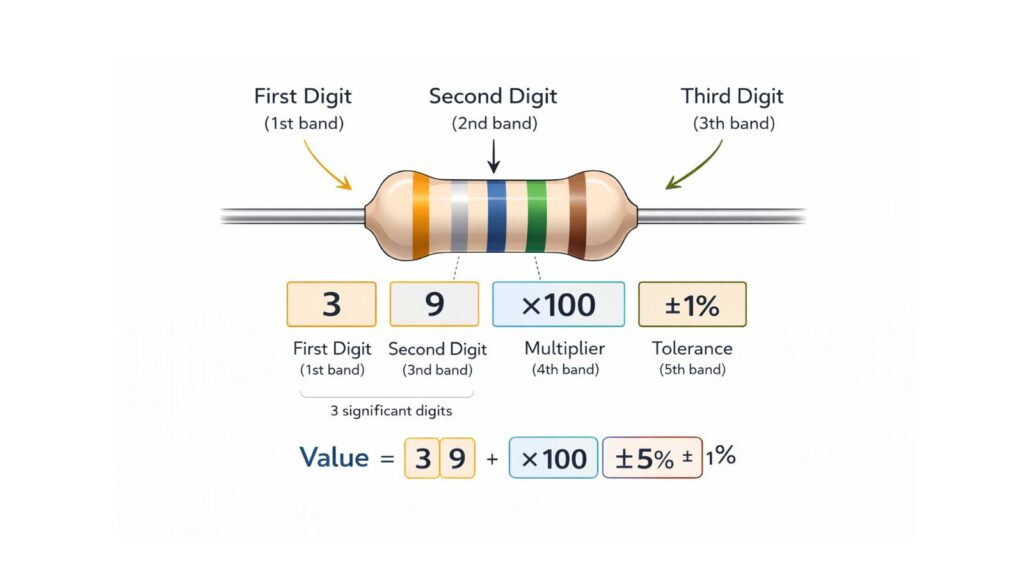
A 5-band resistor is read like this:
Band 1 = first digit
Band 2 = second digit
Band 3 = third digit
Band 4 = multiplier
Band 5 = tolerance
This format improves precision because you have three significant digits instead of two.
Example 1: Brown Black Black Red Brown
Brown = 1
Black = 0
Black = 0
Red multiplier = 10²
Brown tolerance = ±1%
Value is 100 × 10² = 10000 Ω = 10 kΩ ±1%
Example 2: Red Violet Black Brown Brown
Red = 2
Violet = 7
Black = 0
Brown multiplier = 10¹
Brown tolerance = ±1%
Value is 270 × 10 = 2700 Ω ±1% which is 2.7 kΩ ±1%
In precision analog circuits, those extra digits reduce ambiguity and help with matching.
6-band resistor color code
A 6-band resistor is read like this:
Band 1 = first digit
Band 2 = second digit
Band 3 = third digit
Band 4 = multiplier
Band 5 = tolerance
Band 6 = temperature coefficient (tempco)
Tempco tells you how resistance changes with temperature, usually in parts per million per degree Celsius (ppm/°C). In practical terms, lower tempco means better stability.
You will see 6-band resistors in instrumentation, precision references, and stable filter networks.
Example: Blue Gray Black Brown Brown (plus a 6th band)
Let us assume the 6th band is red, often used for 50 ppm/°C.
Blue = 6
Gray = 8
Black = 0
Brown multiplier = 10¹
Brown tolerance = ±1%
Red tempco = 50 ppm/°C
Value is 680 × 10 = 6.8 kΩ ±1%, with a defined temperature drift.
Even if you do not memorize the tempco colors, a resistor color code calculator can decode it instantly.
Tolerance colors you will see most often
These are common tolerance bands:
Brown = ±1%
Red = ±2%
Gold = ±5%
Silver = ±10%
Some precision resistors go further:
Green = ±0.5%
Blue = ±0.25%
Violet = ±0.1%
Gray = ±0.05%
In day-to-day work, gold and brown are the most frequent.
Common mistakes when reading resistor bands
Most wrong resistor installations happen for predictable reasons. If you know them, you can avoid them.
The first mistake is reading from the wrong side. This swaps digits and turns 4.7 kΩ into 7.4 kΩ, or worse.
The second mistake is confusing similar colors. Red and brown are close in dim light. Blue and violet can look similar. Gray can look like faded white. Always use good lighting. A phone flashlight helps.
The third mistake is ignoring the multiplier band. People read the first digits correctly but pick the wrong scale. This is common between red (10²) and orange (10³), which shifts the value by 10 times.
The fourth mistake is assuming the tolerance band is a digit band. Gold and silver are usually measured in tolerance, not digits. But gold can also be a multiplier. You need to look at the band position.
The fifth mistake is not considering that resistors can be dirty or heat-stressed. On repaired boards, the paint can darken. In high-power resistors, the body can discolor. That is a strong reason to measure with a meter.
When you should verify with a multimeter
A resistor color code calculator is fast, but it cannot detect damaged parts. A multimeter can.
Measure the resistor when it is part of a safety function, like a bleeder resistor in a power supply. Measure it when it is in a precision divider setting an ADC reference. Measure it when it is in a timing network where a wrong value will shift the frequency.
Also, measure when the resistor is already soldered into a circuit. But remember something important. In-circuit measurements can be misleading because parallel paths change the reading. If the value matters, lift one leg and measure out of the circuit.
Resistor color code calculator: why is it worth using?
Even if you are good at reading bands, a resistor color code calculator saves mental effort and reduces mistakes. It is especially helpful in these situations.
You are working quickly and sorting many resistors.
You have a 5-band or 6-band resistor and want instant confirmation.
You are teaching students and want them to focus on circuit meaning, not memorizing colors.
You are writing lab reports or documentation and need clean values in ohms, kΩ, or MΩ.
In engineering, speed is useful, but accuracy is essential. A tool gives you both.
How to use a resistor color code tool effectively?
Most resistor color code tools work in one of two ways.
The first method is band selection. You choose the band count (4, 5, or 6). Then you select each band color from a dropdown. The tool outputs resistance, tolerance, and sometimes min and max range.
The second method is reverse lookup. You input a resistance value and tolerance. Then the tool suggests band colors.
A good workflow is simple.
First, choose the correct band count. Many people pick 4-band by habit and get wrong results for a 5-band resistor.
Second, hold the resistor so the tolerance band is on the right.
Third, input band colors left to right.
Finally, compare the tool result with what you expect from the circuit.
If you are designing a circuit, reverse lookup is also helpful. It lets you see the actual band colors you will look for in a resistor kit. This reduces assembly mistakes for students and technicians.
Practical examples from real circuits
LED current limiting resistor
Suppose you want about 10 mA through a red LED from a 5 V supply. A rough design might use 330 Ω.
A common 4-band 330 Ω resistor is Orange Orange Brown Gold.
Orange = 3
Orange = 3
Brown multiplier = 10¹
Gold tolerance = ±5%
So 33 × 10 = 330 Ω. If a student accidentally installs 3.3 kΩ, the LED will be very dim. If they install 33 Ω, the LED may be too bright and could fail. This is why quick decoding matters.
Voltage divider for an ADC
If you are scaling a sensor voltage, you may need a precise divider ratio. You might use 10 kΩ and 2 kΩ with ±1% tolerance. Those often come as 5-band resistors.
A resistor color code calculator helps students verify that they picked the correct precision parts from the lab drawer.
Pull-up resistors in digital circuits
In microcontroller boards, 4.7 kΩ and 10 kΩ pull-ups are common. Those values are easy to mix up by sight because they share similar digit bands in some cases. Confirming with a tool avoids wasted hours chasing “random” I2C issues that are really poor pull-ups.
What about SMD resistor codes
Surface-mount resistors usually do not use color bands. They use printed numeric codes like 103 (10 kΩ) or 472 (4.7 kΩ). Precision SMD resistors may use four-digit codes.
Even if your main focus is on through-hole color codes, it is useful to recognize this difference. If you are reading a board and you see tiny rectangles with “102”, do not search for bands. Use an SMD code chart or an SMD resistor calculator.
Quick sanity checks engineers use
When I am verifying a resistor value quickly, I ask a few simple questions.
Does this value make sense for the function?
A series resistor for an LED is usually tens to hundreds of ohms, not megaohms. A pull-down resistor is often 10 kΩ to 100 kΩ, not 10 Ω.
Does the physical size match the expected power?
A tiny 1/8 W resistor in a mains dropper position is a red flag.
Does the tolerance match the circuit sensitivity?
If the circuit needs accurate gain, ±5% resistors are risky unless you designed for it.
A resistor color code calculator helps confirm the exact value, but your engineering judgment provides the context.
FAQ about resistor color codes
How do I know if a resistor is 4-band or 5-band?
Count the bands. If there are four, it is almost certainly a 4-band resistor. If there are five, it is a 5-band resistor. If there are six, it includes a temperature coefficient band. Also, check spacing. The tolerance band is usually separated slightly from the others.
What does the gold band mean on a resistor?
Gold is most commonly the tolerance band, meaning ±5%. In some resistors, gold can be a multiplier of 0.1, but its position matters. If it is the last band and separated, it is usually tolerance.
Can I trust the color code if the resistor looks burned?
Not fully. Heat can darken or alter band colors. If a resistor has been overheated, measure it with a multimeter. Also, check if the resistor drifted out of tolerance.
Why do some resistors have a sixth band?
The sixth band indicates the temperature coefficient, usually in ppm/°C. It tells you how much the resistance changes with temperature. This matters in precision circuits.
Is a resistor color code calculator accurate?
Yes, for decoding, as long as you input the correct colors in the correct order. It cannot detect damaged or drifted resistors. Use a multimeter for that.
Final thoughts
Learning the resistor color code is one of those skills that pays you back forever. It makes you faster on the bench, more confident in labs, and more reliable in professional work. Once you understand the logic, reading 4-band, 5-band, and 6-band resistors becomes routine.